
About the Dream Shop
You might be surprised to learn that the Dream Shop is a very small, craftsman-based shop. It’s really ‘just me’, doing all the research, art, layout (and sweeping the floors, going to the post office and taking out the trash) I am lucky to have a few part time helpers, doing shipping, cutting and stitching. While we work very hard, our capacity is limited, but everything we touch is as perfect as it can be. I’ve written this to tell you how we came to be.
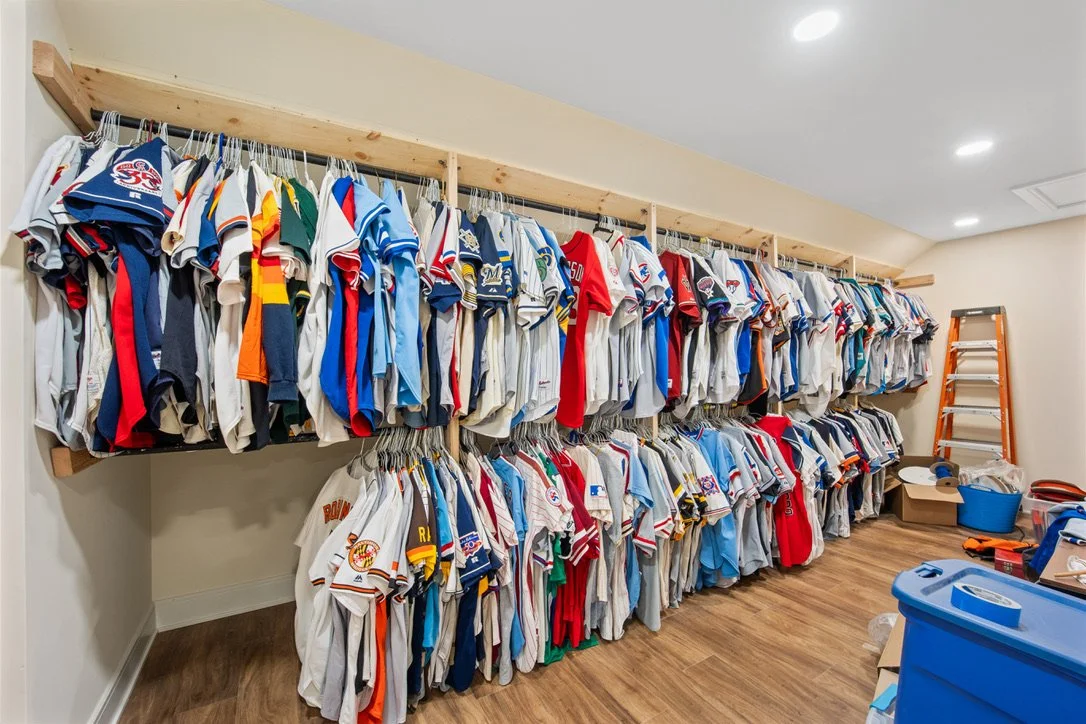
“The Dream Shop” is the name I’ve chosen for my practice of authenticating, restoring and pro lettering MLB jerseys. With a nod to the iconic baseball movie The Field of Dreams, our moniker relates more to my dream of doing this work in my retirement following a long international marketing career in corporate America. I’ve been a serious MLB jersey collector for decades, and in the pursuit of my hobby I have collected a single example of nearly every jersey in every style worn by every team since the double-knit era began around 1972. That’s a lot of jerseys— over 1500 at last count. They are all arranged, hanging in alphabetic order and by year close at hand.
When I began collecting, and the Internet was a very new thing, I was both amazed at the resources at my fingertips but also by the misinformation that now circulated so easily. It was back in 1996 that I compiled the modest “First Edition” of the research that became my “Game Worn Guide to MLB Jerseys”. It was about 100 pages long, had no photos, and I printed it for the three friends who asked me for copies. Now, in its Tenth Edition of 2025, it has grown to more than 5,500 pages cataloging thousands of major facts as well as tiny obscure details into a body of work that would have been unimaginable to me “back then.”
The original reason I started compiling this reference is more valid today than it was when I began: as a collector, I recognized there were a lot of fake “Authentic” jerseys out there, or supposedly team-used ones being represented something they weren’t. And the explosion of the Internet (which barely existed in 1996) has made the problem both better... and so much worse! “Better” in that there are so many jerseys being sold by so many individuals that there are opportunities and bargains galore. “Worse” in that the number of fakes, misrepresentations, counterfeits and frauds has increased exponentially. Originally, my handwritten notes that eventually became this book simply detailed which years memorial and commemorative patches were used, when player names-on-back (NOB) were used or not, when nameplates were used, when team styles changed from pullovers to button-fronts, and a host of other details that would allow me to tell with a simple search when something was being represented as something it was not.
The Game Worn Guide to MLB Jerseys is part of the research library of the Baseball Hall of Fame and Museum in Cooperstown, New York, is referenced constantly in the hobby, and is used by almost everyone in the trade. I have been lucky to have been interviewed by multiple organizations including The New York Times/The Athletic and Sports Illustrated, USA Today and Sports Weekly. I also need to give a heartfelt nod to my favorite website, Paul Lukas and uni- watch.com; sadly now sunsetted into history.
As a collector, back in the 1990s I often sent jerseys to shops for customization or restoration, and frequently I was disappointed by the experience. Communication was poor, and it would be months of waiting and many phone calls before my jerseys were returned to me; sadly often lettered improperly. I generally just lived with them that way, because it was more trouble than it was worth to address the problems.
Around 2010 I was so lucky to meet Patsy Elmer, founder of Big Time Jerseys, operating in the suburbs of Phoenix, Arizona. Patsy was the first person I met who seemed to care about doing things right- and we began to share knowledge and trade skills. I would send Patsy jerseys to letter along with carefully recreated computer files of jersey fonts I had made. Before long I began doing all her layout for her jobs for other customers, and she began sewing all my jerseys. Some five years later she helped me get my first computer-assisted lettering cutter, and as she picked up more pro teams’ business, she started to refer her smaller MLB customizations to me. When I retired from corporate life around 2018, I had a head start into starting my own small shop, in the tiny basement of my house.
The Dream Shop does not do team orders, and we focus solely on baseball though we occasionally restore valuable collectible jerseys from hockey, football and basketball. While in our early days we did some customer lettering for the NFL and NBA, I quickly decided that this was not the best use of our time and dialed things back to focus on what we were the best at.
Before long people started sending us old uniforms to restore. To those unfamiliar with Major League Baseball in the old days, that would be before 1995, teams regularly sent all of their old uniforms to the minor leagues to be reused there until they were eventually ready to be discarded as rags. The advent of the Internet caused a lot of these relics to come up for sale, and collectors wanted to find somebody who could restore them properly, and my name seemed to come up more and more often in conversation.
Because of my experience with collecting, research on authenticity, and restoration, branching into pro authentication was a natural extension of my discipline. Over the years I've been critical of authenticators who seem to stray far out of their lane, offering opinions on things that they probably didn't know very much about. My commitment was that I would stay focused only on those things in which I have a dedicated expertise: I stick to baseball uniforms. Today you shouldn't be surprised to see my letters of opinion attached to many jerseys being sold by major auction houses as well as private collectors on auction sites. I am lucky to count several of the major auction houses as clients, and besides authentication I have restored some very rare pieces which you can read about as you peruse this website.
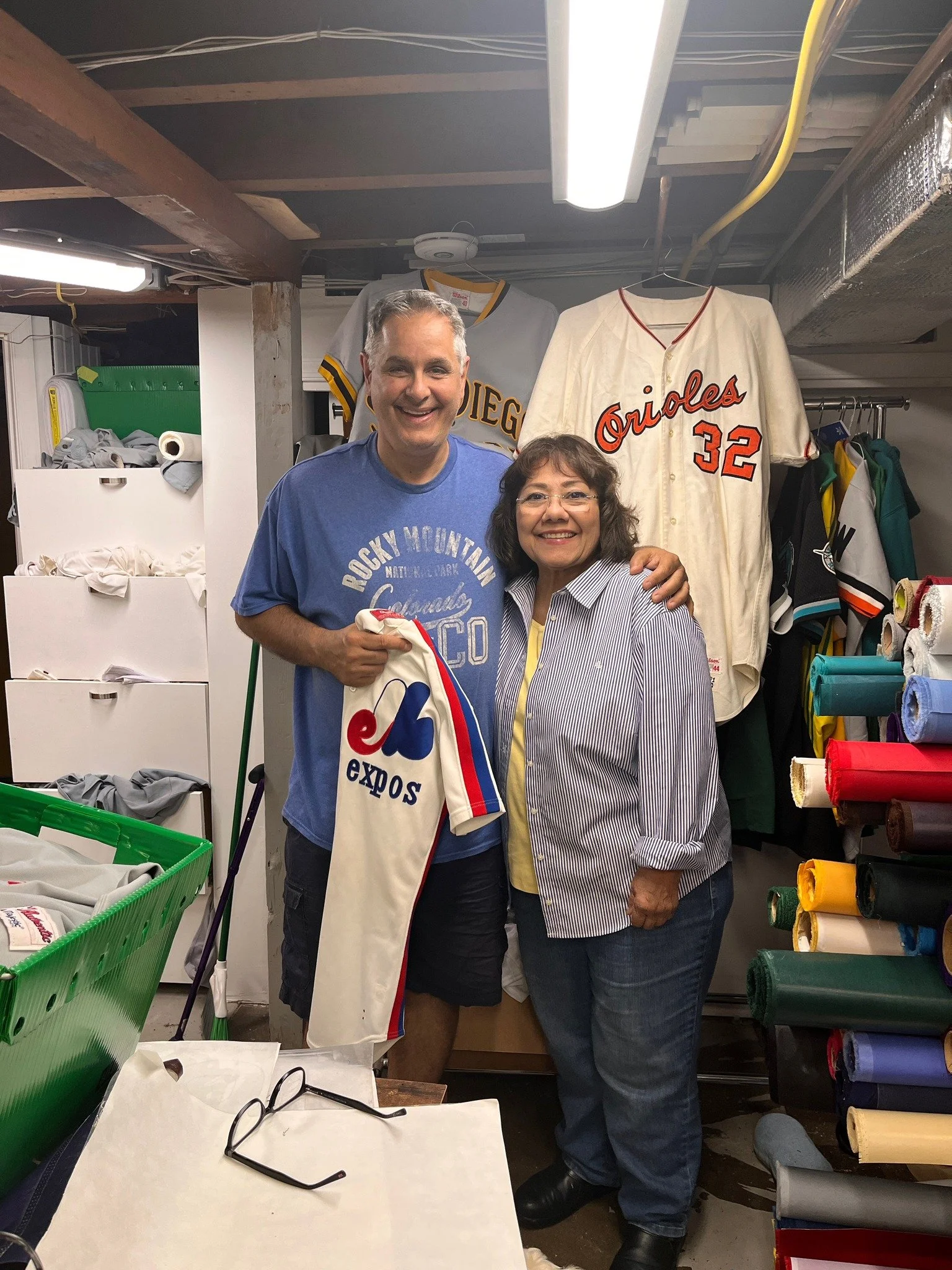
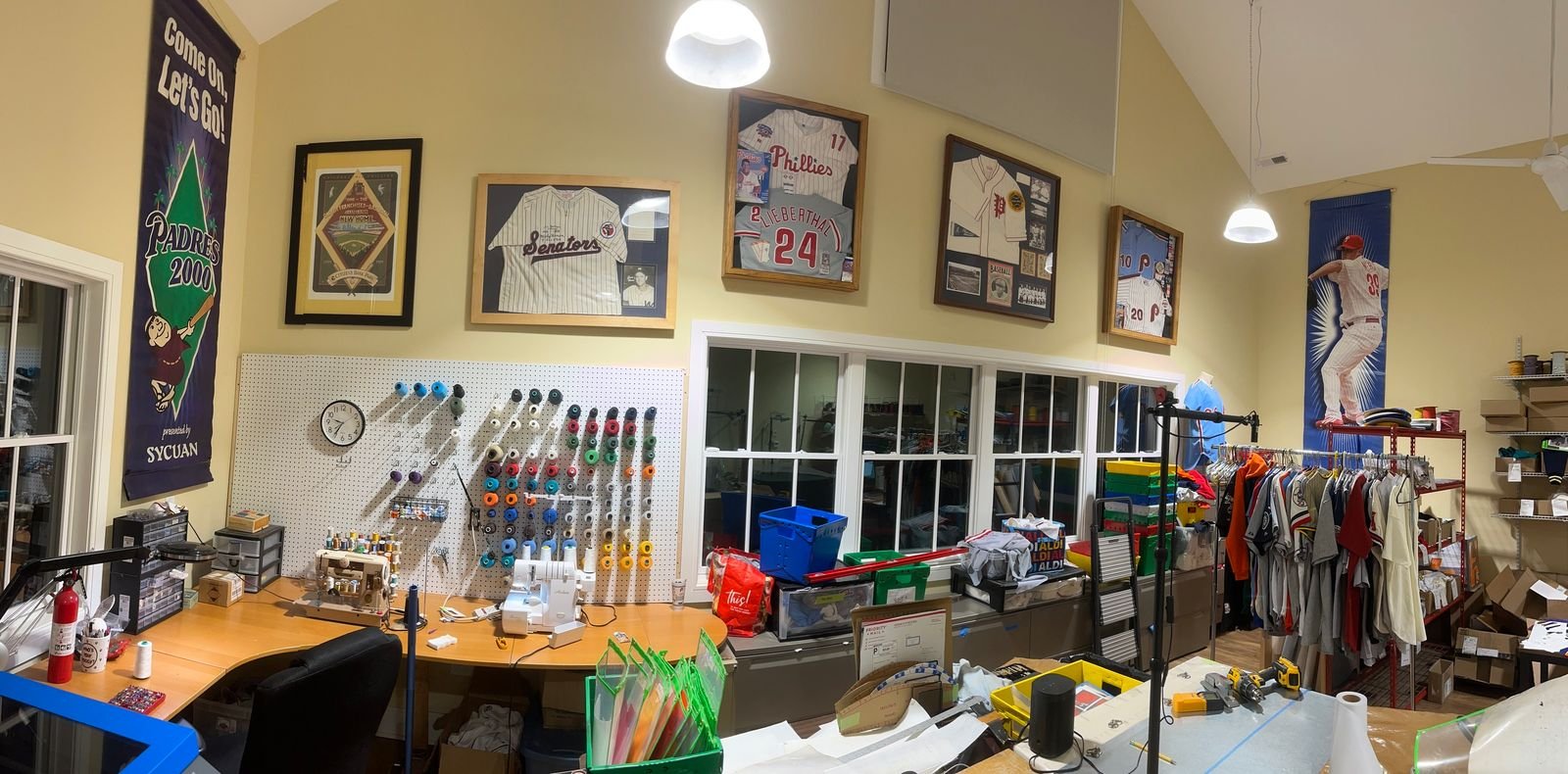
In 2024, we marked a major milestone: we relocated, renovating a home out in the country with a large workshop attached to it. No more bumping our heads on the pipes in the basement. In my retirement, this is where I spend many happy hours, actually many more hours than my wife would prefer. We pride ourselves on frequent communication with our many customers, giving them good estimates of when their work will be done. And when the workload gets too large, we sometimes will stop accepting orders for a number of weeks until we can catch up with the backlog. At no time do I like our normal delivery schedule to stretch beyond 10 weeks. The thing I am most proud of besides the quality of our work is the number of customers that we have. Most businesses are lucky to have a 20% repeat customer rate. Ours approaches 80%, an astounding figure. Chances are good if we do one job for you we're going to do another, and then another.
We are glad to make your acquaintance and would like to help you make your dreams come true as well.
-Bill Henderson
Lettering Fabrics: Standard and Specialty
The foundation of authentic jersey lettering is using the right fabric — and not all twill is created equal. Our standard pricing is based on tackle twill, the durable, colorful fabric that became the industry standard for Major League Baseball during the 1970s. Look closely and you'll see a subtle diagonal micro-ribbed pattern that catches the light slightly differently depending on the angle. It was a game changing fabric invented by the Liebe Company, still a major supplier today through its Webster Fabric division. We also source premium twill from Stahls. We use the good stuff, full stop.
We always do our best to color match to the various shades that were used over the years by the different teams. Did you know there's about six different shades of Royal blue, and about five different shades each of orange and gold used by MLB?
Beyond standard tackle twill, we stock a range of specialty fabrics that reflect what specific teams actually used in specific eras. These are available at a modest upcharge reflecting both material cost and the additional care required to work with them correctly.
• Glitter Twill — Sparkly gold, silver, or copper twill used by teams like the Marlins, Rockies, and Diamondbacks as standard practice, and on a number of limited edition World Series championship jerseys.
• Glacier Twill — A herringbone-patterned fabric used primarily by the New York Mets throughout the 1990s and 2000s.
• Dazzle Twill — A micro-ribbed shiny fabric that catches the light dramatically when turned. Most associated with the 1980s Mets and Houston Astros.
• Linen Twill — A flat-finished cotton fabric used in place of standard tackle twill by several teams early in the double-knit era, including the Cleveland Indians and Astros.
• Dodger Twill — A non-reflective double-knit fabric used predominantly by the Dodgers through the 1980s and 1990s, with some crossover to other teams including the Astros.
• Felt — Both wool and synthetic blend, as used by teams prior to 1970.
• Hybrid Felt/Tackle Twill — From the late 1950s through 1972, some teams used layered combinations of felt and tackle twill — sometimes felt on top, sometimes on the outline layer. Teams including the Orioles and Mets used this technique. We have detailed charts documenting exactly which team used which configuration in which years.
• Nike Twill — The flat, non-reflective fabric used on some 2020s All-Star jerseys and exclusively during the 2024 and 2025 VPE seasons, produced in the slightly different color shades specific to those years.