
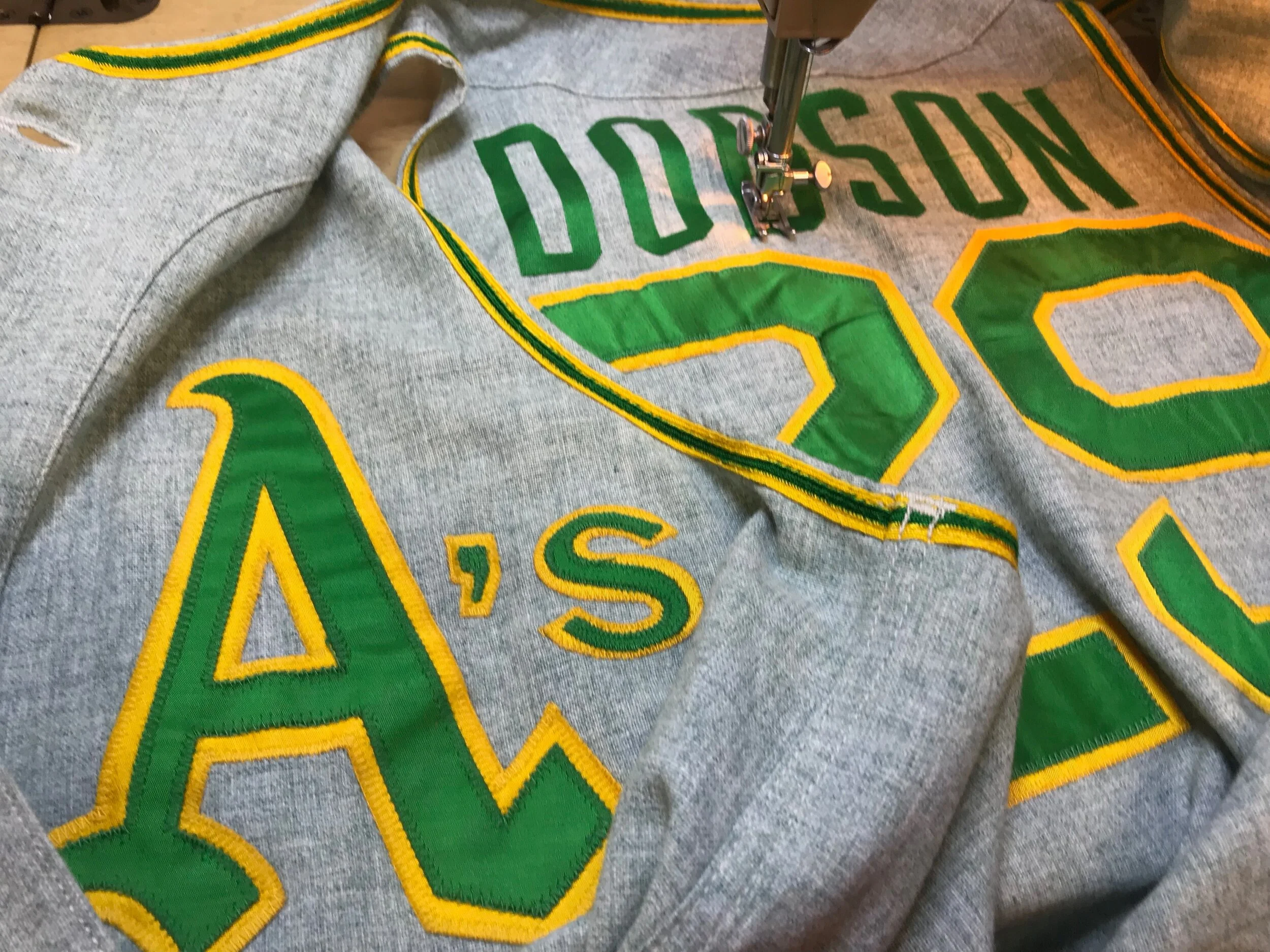
Jersey Restorations
Through the 1990s, every team sent its game-used uniforms to spring training camp or the minor leagues to live a second life. There, they were often stripped of their original numbers, patches and even their front team crests and re-lettered. Rediscovered as hidden treasures by collectors decades later, we can bring these back to life, returning them to their original appearance.
Important: What you need to know first
Risks and Rewards
Any restoration job has inherent risks. As when choosing a professional for any job— be it a surgeon, a lawyer or a builder to remodel your kitchen, you ultimately must rely on their expertise, references and your own common sense when evaluating recommendations.
First, I have insurance, but do you have insurance? That seems like a boring place to start, but it's quite realistic. If you are sending me an item that is potentially worth $50,000, do you have your own insurance policy if it is lost in transit or is damaged somehow? Regardless of any insurance I have, you want to be sure that any item that you are sending me is covered under an insurance policy at your end.
For my part— I am insured against theft, fire and total loss. In fact, insurance is one of my most significant monthly expenses. But my goal is clearly avoiding any of these events. In my practice I have restored hundreds of jerseys. I have a great deal of experience in knowing what is effective and what is not worth trying and can help you by making experienced recommendations. But whenever lettering must be removed or fabric cleaned, there is always the small danger of damage occurring, despite my best efforts, and as a collector you must be willing to assume risk for this happening. (The document attached here goes much deeper into this topic.)
Budget
I realize that most of you are as fanatical about accuracy as I am. While I have done restorations of jerseys that have sold for over $500,000 at auction, I do far more restorations of jerseys that belonged to common players that are worth a tiny fraction of that. I’ll have a budget discussion with you before we begin the project so I can understand your objectives and cost concerns. I’ll share my ideas about issues we might face, my hourly rate and how long I think the job will take.
One thing I won't do is cut corners; I won't do a sloppy restoration. And I can honestly tell you that to date no one has even insisted that I do so. If you have something worth restoring I'm going to do it right, and I'm going to tell you about how much it's going to cost. You can decide what to do.
Timing
I do all restoration-class work myself, so it is important to be realistic about scheduling this work, and how long it might take. I try to balance the value of the item on which I am working with the actual need for it to be here for an extended period of time. For some projects I may recommend scheduling your project in advance. Sort of like getting the “fast pass” ticket at Disney World. I'll tell you when to send your item in so that, once here, that it sits and waits in the queue for the least amount of time. In turn, I'm going to ask you to send a deposit in advance and keep the commitment to send your jersey when it is your turn. By reserving a slot for you I will be changing the expectations of others who are sending me their work so it's only fair.
Proper Documentation of your Restoration
I say this without any hesitation: any jersey worth a restoration is worth being properly documented. One of the biggest mistakes a collector can make is have a jersey restored and not have documented the process. I will explain why. When I restore your jersey, I will do my best to exactly cover the original ghosts, forever obliterating them from view. In the future, an authenticator (or potential buyer) inspecting the jersey on a light table will see only one thing: the ghosts from the later re-issue of the jersey that we carefully have undone. Their conclusion may well be that the jersey has been tampered with to turn it into something it was not. Let me be clear: You do not want your jersey to fail an authentication. In our digital age, authentication databases are well accessible, so that the next person researching your jersey at another place and time may stumble on this data and at its very worst, incorrectly suspect you are trying to commit a fraud.
I always propose full documentation of any restoration. This comes in two flavors: a simple letter of restoration, and a full document of my authentication opinion. A letter of restoration simply explains what was done. It does not give any information on the history of the item or claims as to who may have worn it or whether or not it is authentic. It simply documents what we did, before and after. Conversely, a full authentication goes into all of the detail that explains what an item is, when it was used and how it came to be what it is now. It associates the garment with the player and the season(s) in which it was used. To learn more about this skip to the section on authentications.
“Restoring” a game jersey, changing it to the name/number of another player who did not wear it.
Let’s say you just purchased a team tagged jersey from the 1978 Yankees worn by a backup infielder and want me to number it for Reggie Jackson. Will I do it? Possibly, but with some very important and non-negotiable terms. We are not at all interested in fooling anyone, or especially being a part of some future fraud that happens somewhere down the line after you don’t own this item any longer. (sadly, this stuff happens.) This arena is a whole different topic, and rather than try to explain it here, let me refer you to this document that covers the issue in detail. As always, we reserve the right to refuse any project.
What Happens in a Restoration?
Every restoration starts with research. In the light room, the light tables and intense UV “Black” lights can help reveal a jersey’s history. I study team rosters as well as searching my archives of hundreds of thousands of period photos helps me learn exactly how the team uniforms of any given year were made, as well as who made them, and how they were tagged when new by the manufacturer for the team.
After evaluating the subject, taking detailed photos of its current appearance, I can begin by carefully stripping it of its minor league or spring training lettering, then cleaning it using multiple methods.
Once I’ve stripped and cleaned it, re-examining it in the light room will usually tell me what I need to know. I am a professional digital artist. Working with professional drafting, photographic and design software, and calling on my own library of hundreds of painstakingly reproduced team fonts going back to the 1930s, I can begin to mock up how it would have looked originally, creating art that overlays the original ghosts perfectly. Every restoration has a proof-approval stage where the collector reviews and approves the work that is to be done before a single stitch is taken.
I cut new lettering and scripts from the original materials, whatever they are (felt, tackle twill or several other specialty fabrics) and the stitching is done in the original manner. Sometimes lettering needs to be media blasted or dyed to help it match the surrounding fabrics for textural harmony.
If original sleeve patches are not available and no suitable reproductions can be found, I can often also recreate these.