
Restoration / Authentication
1976 "Diamond in the Rough"
"A Diamond in the Rough"- They are still out there, many hiding in plain view. Here is one such restoration I recently completed on one of the 1970s most infamous breaches of baseball tradition that alarmed purists and finally caused the Commissioner to take swift action. Read on for the full story!
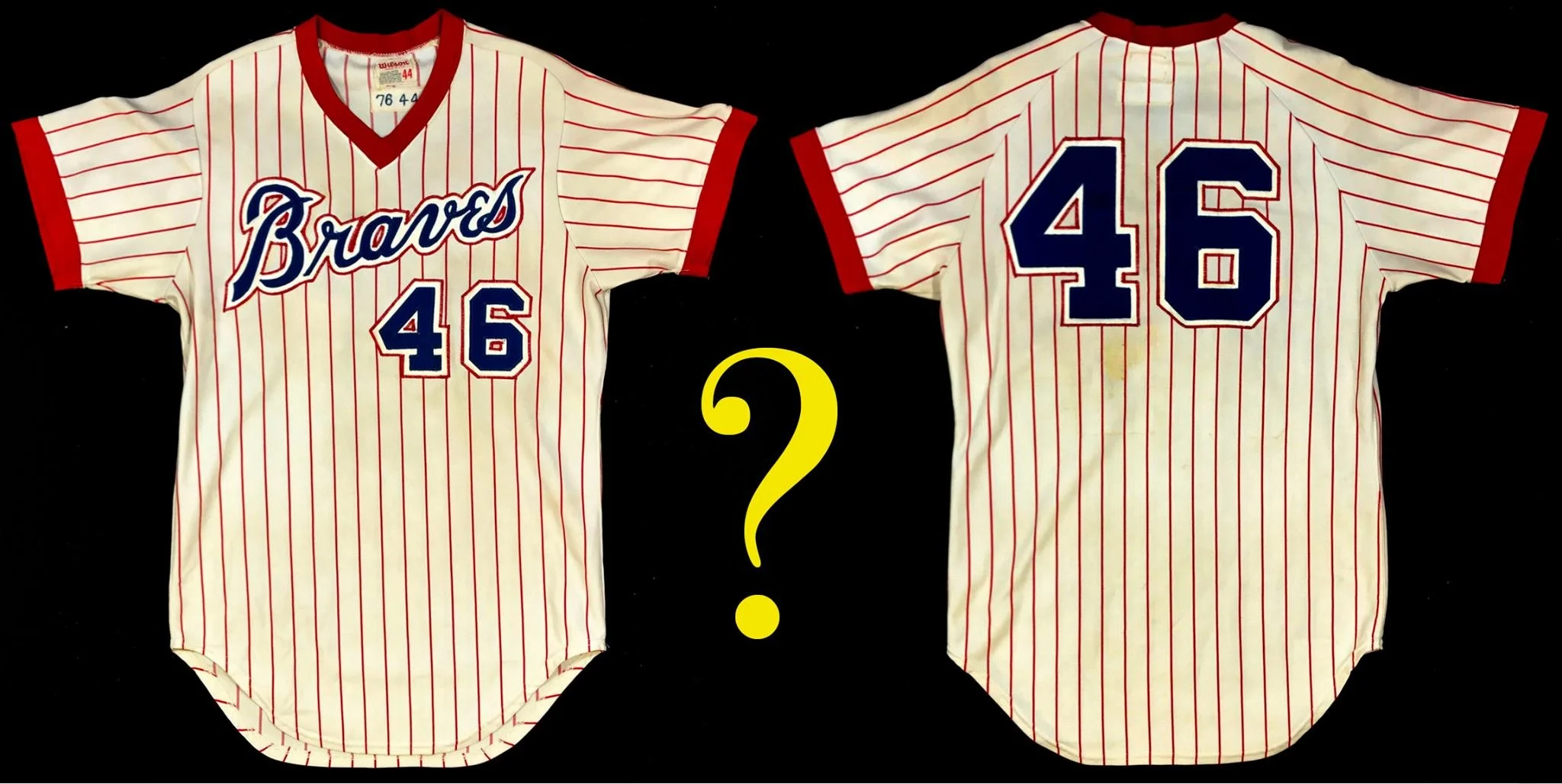
“Is this worth restoring? And what is it? These were the questions that collector Guy H. Asked me. He sent me photos of a rather dingy Braves jersey in the uncommon style worn only 1976-1979. I was intrigued. These were the uniforms the Braves had adopted right after the “feather style”: that Hank Aaron was famously wearing when he hit his record breaking home run, and the style they wore when I was in high school. *** I knew that the organization had multiple minor league clubs also named “Braves” and very often wore their own Braves jerseys from the 1970s-1980s, and that these are frequently incorrectly represented as MLB issue when they had actually started their lives for from Atlanta, sewn as minor league uniforms from day one.
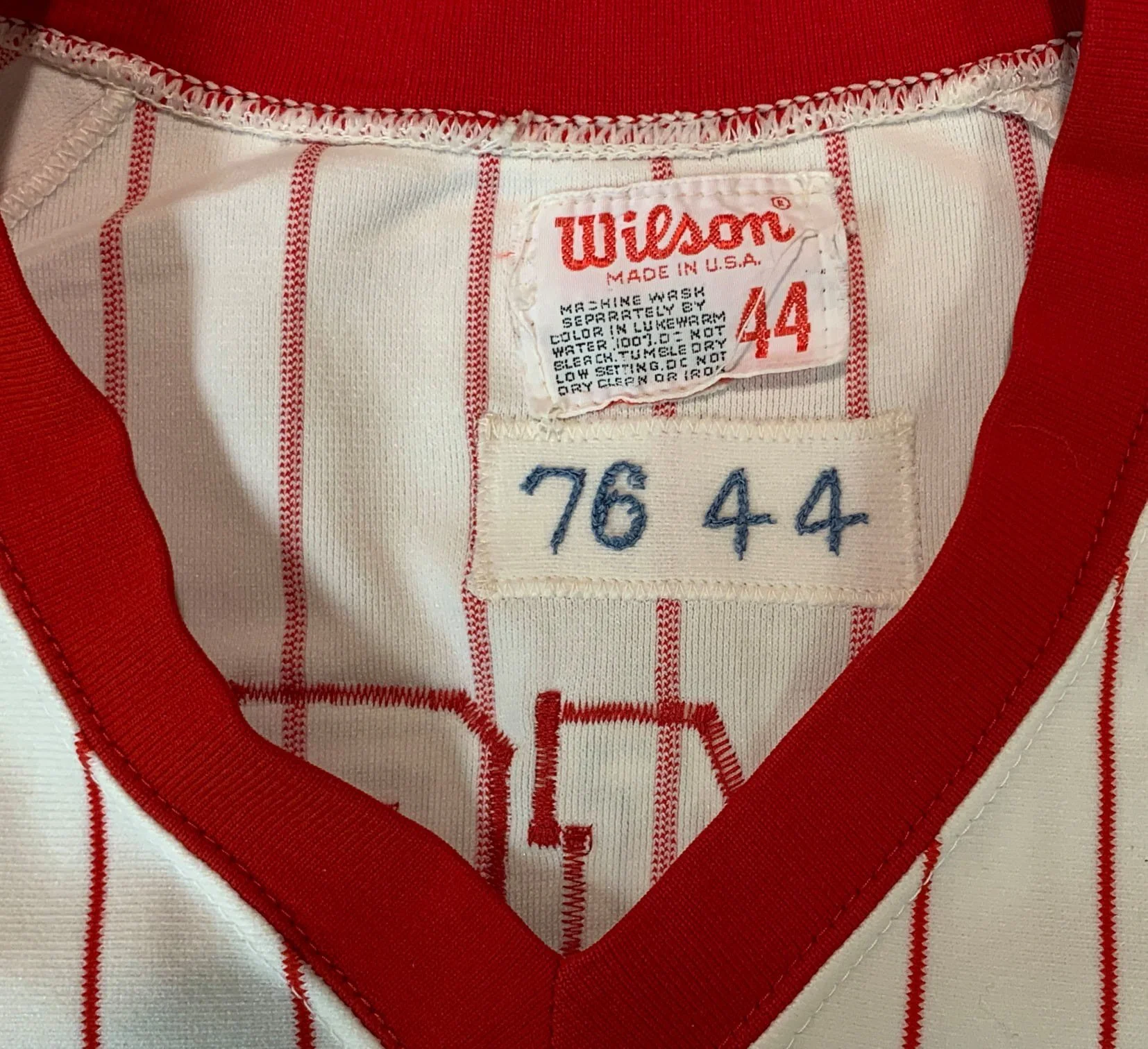
“Send it along", I suggested. Let me take a look at it on the light table and see what I can learn. I was hopeful. Even though it had clearly had a number change,. The “76 44” team tagging in the collar offered promise.
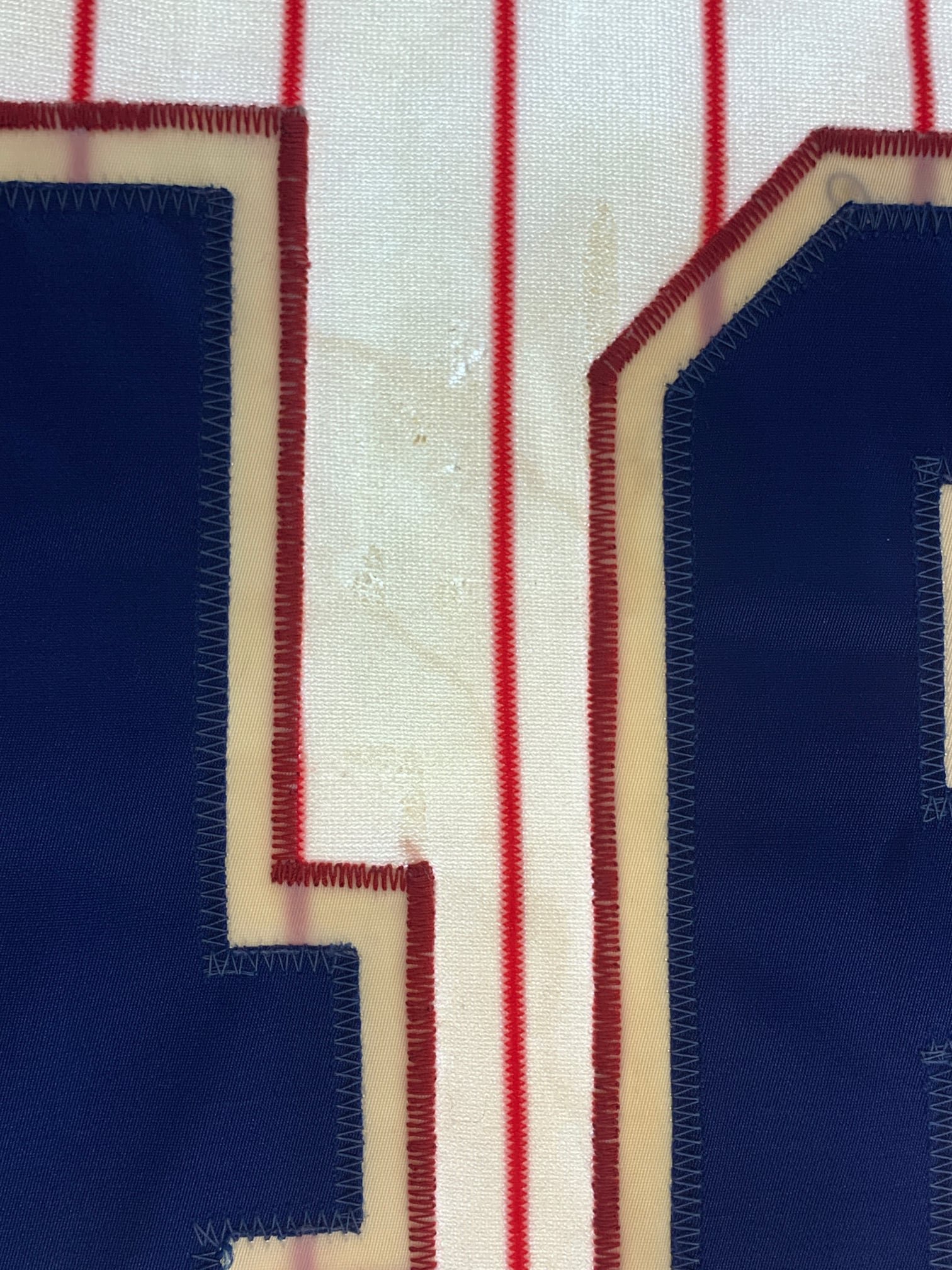
When it arrived, it was clear that the jersey had done several tours of duty. While the front numbers could have been original, The back numbers were not, and on the light table it was clear that another set of two numbers had been on the back before, sewn uncharacteristically low. But odder still, there was some slight fabric scarring right between the two back numbers up near the top of the back of the shirt. Not much, just a couple of stray lines, and while they extended under the current back numbers, it didn’t look long enough to be anyone’s name.
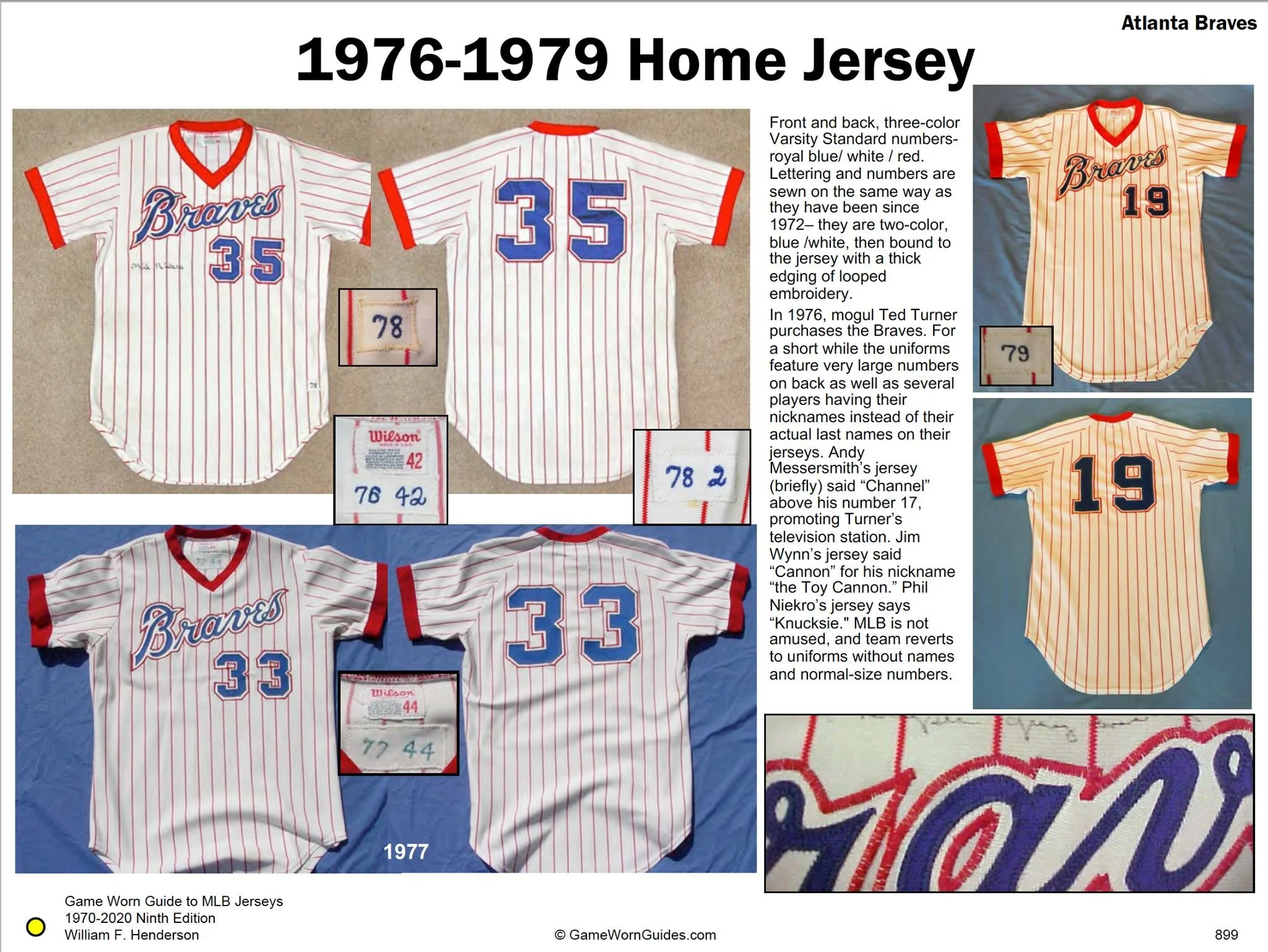
Besides, MLB Braves home jerseys in 1976-79 didn’t have player names on back, they didn’t appear until 1980 and after the NEXT uniform style change…and minor league teams didn’t generally use player names on back. What was it?
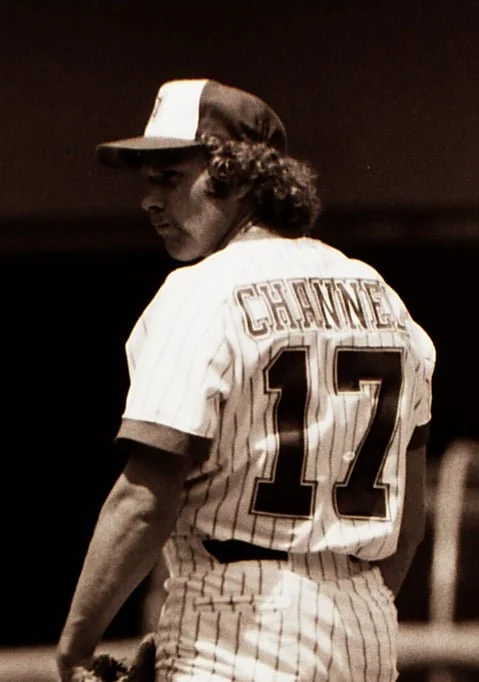
But wait— Low-placed numbers…. Name on back… it occurred to me suddenly. Yes, the Braves DID briefly use names on back, in early 1976, and literally for only a few weeks. When mogul Ted Turner bought the team, he outfitted them with flashy new uniforms that incorporated player nicknames instead of the traditional use of player last names on the jersey backs. Traditionalists rolled their eyes, but Turner was a showman and after-all, there was no rule saying you couldn’t do this… All was tolerated by the league, until Turner crossed an invisible line by having pitcher Andy Messerschmitt appear wearing the number 17 with the word "CHANNEL" above it, slyly advertising Turner’s TV station. At that point the commissioner stepped in and said that this had to stop. Quickly, the jerseys were gone, and the team appeared unceremoniously after May 22 wearing a brand new set of uniforms with no names at all on back. What happened to the nickname jerseys?
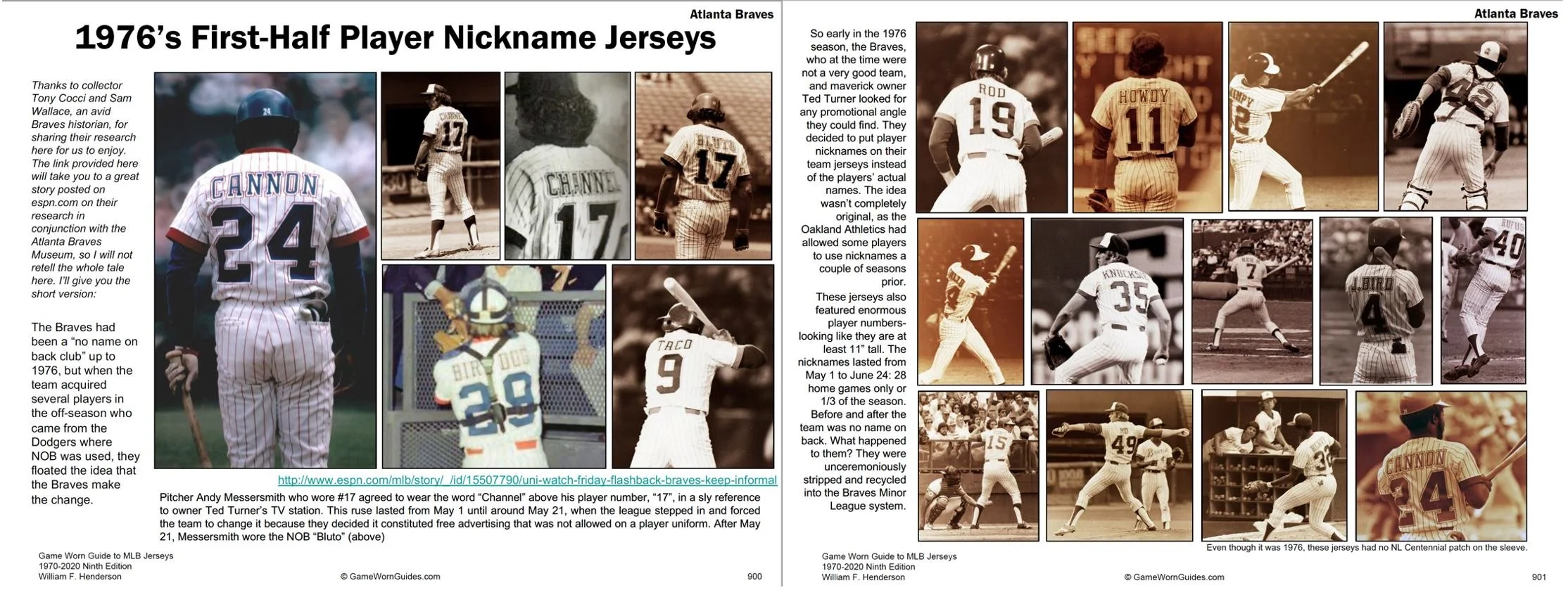
You can see the pages from my book, here. (Thanks to collector Tony Cocci for his help assembling this research) Very, very few of these jerseys have ever surfaced, and their whereabouts were generally a mystery. Collectors had unearthed a few, but for the most part, these had been lost to the ages in the intervening, nearly five decades. Back then, people didn’t collect this stuff, and teams reissued their equipment, including player uniforms, using them again and again until they were finally discarded.
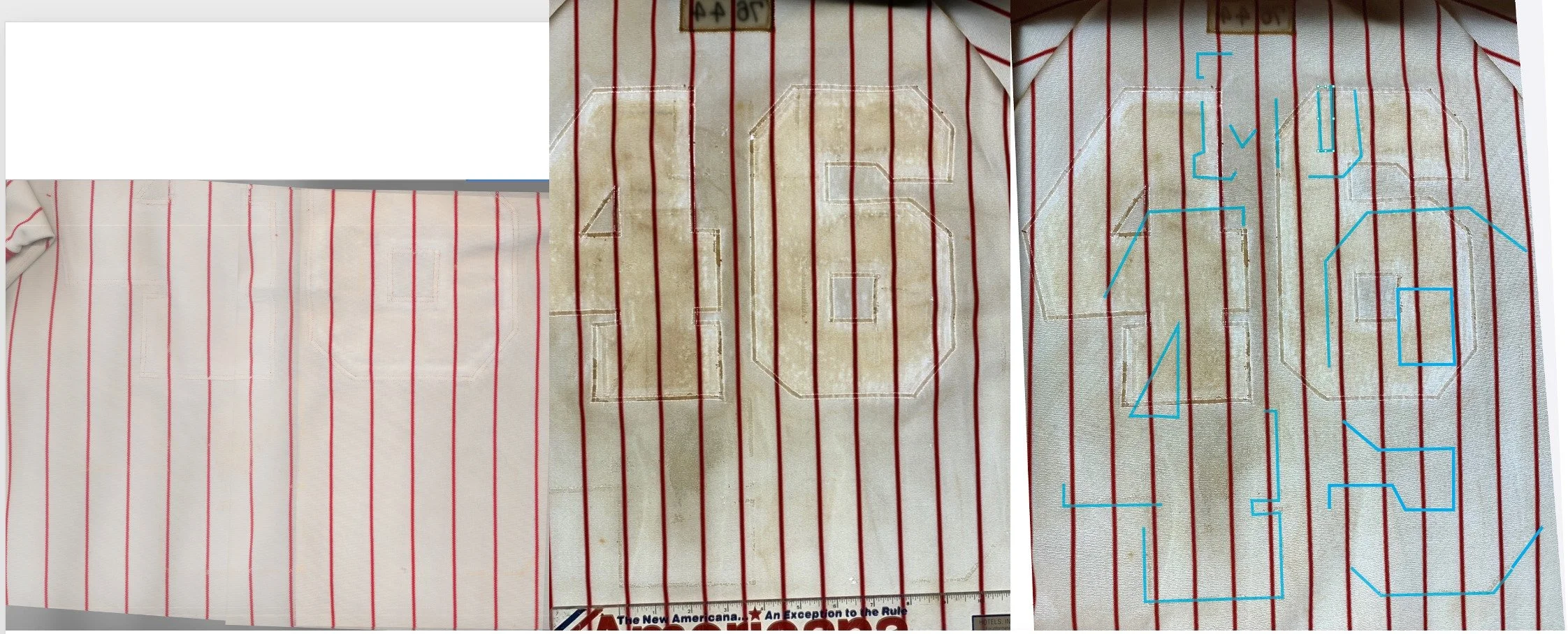
I strongly suspected we had found one of these rare beasts, hiding in plain view. Guy gave me the permission to strip off its back numbers to see what we could learn. The jersey was tremendously dirty, and finding the outlines on the light table was not easy. Look at the photos here- and notice the evidence that shows up on the light table that is nearly invisible to the naked eye. I was able to discern a few lines, and with the old numbers out of the way I could see that these old numbers were huge, almost football jersey sized.. They extended it a full 7 inches below the current numbers, and went nearly to the top of the shirt. I was able to coax out enough faint strokes, glue points and pulls in the fabric that I could see that the original number had been 49. Who was 49 on the 1976 Braves? The answer was pitcher Carl Morton. Searching the Internet and my own files I was actually able to find a photo of Morton, wearing number 49 with the nickname above the numbers “MO”. That 2-letter name on back explained why I could barely see any signs of a typical name that I had expected! **** Now that I knew what I was looking for, I started zoomed in to look for the intersection of any possible shadow lines so I could re-establish the placement and positioning of the 1976 original lettering. Here is what I came up with.
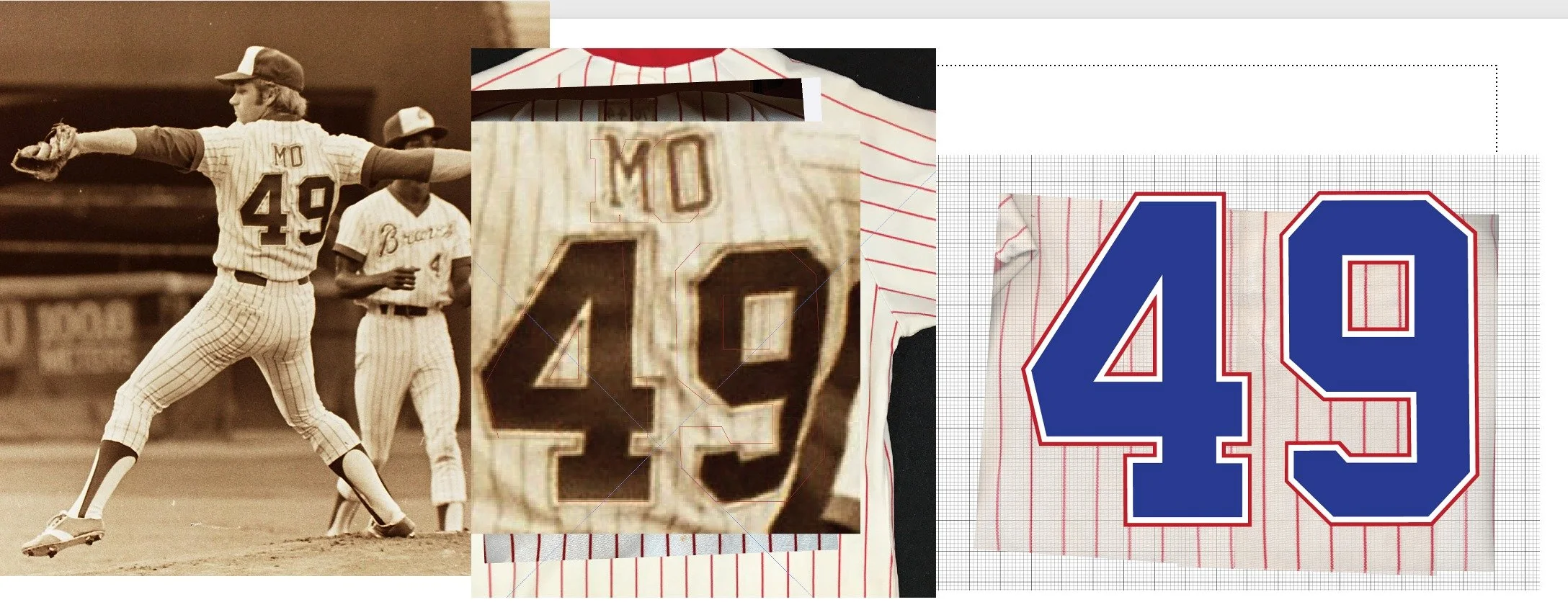
Almost unbelievably, this clear photo we have of Morton shows the entire back of his jersey. I was able to blow it up, I distorted it slightly to “flatten” its angle using Adobe Illustrator, then overlaid it onto the light table scan image of the jersey I had in my hands. And lo and behold, there were multiple pinstripe intersections of each of the shadow lines that I could decipher when compared to that 45 year old photograph!
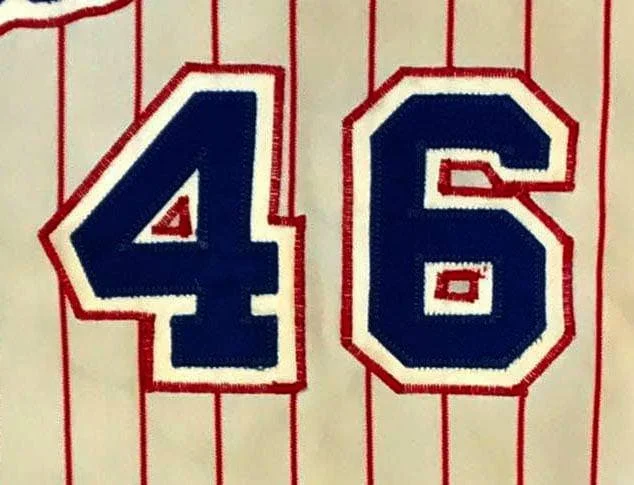
I next turned my attention to the front of the jersey. A couple of things caught my eye. First of all the front numbers looked original. Braves jerseys from this period attached the lettering using a very untraditional method. The lettering was actually two color: blue twill over white, and then the edge of the white fabric was bound to the shirt using a very tight embroidery stitch of red thread. They may have thought it looked fancy and unique, but to my eyes it generally looked somewhat sloppy, and as the years went by the red embroidery faded and frayed and looked even worse, including the fact that the tight stitching caused the fabric of the shirt to pucker badly underneath every single stitched element.
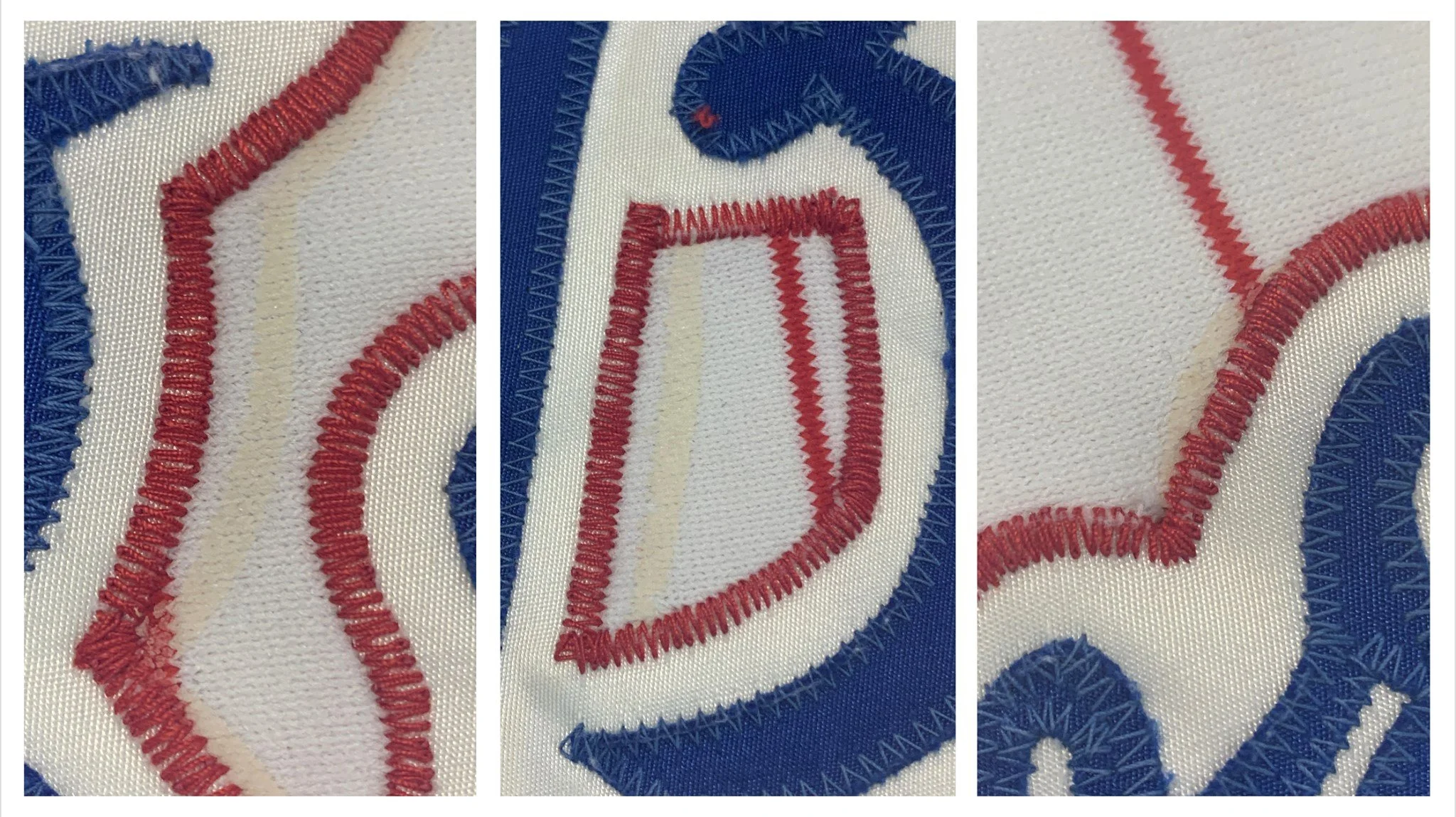
I noted in a couple of places where the Braves wordmark looked like it had been removed and re-stitched. My supposition is that it had gotten so ratty and puckered that the minor-league team ripped out all the red thread, ironed the fabric flat and re-stitched it all back on. It's actually very probable that they did just that: labor was cheap, and teams regularly went to extreme measures to preserve the viability and reuse of old uniforms, a practice they would simply never bother to engage today.
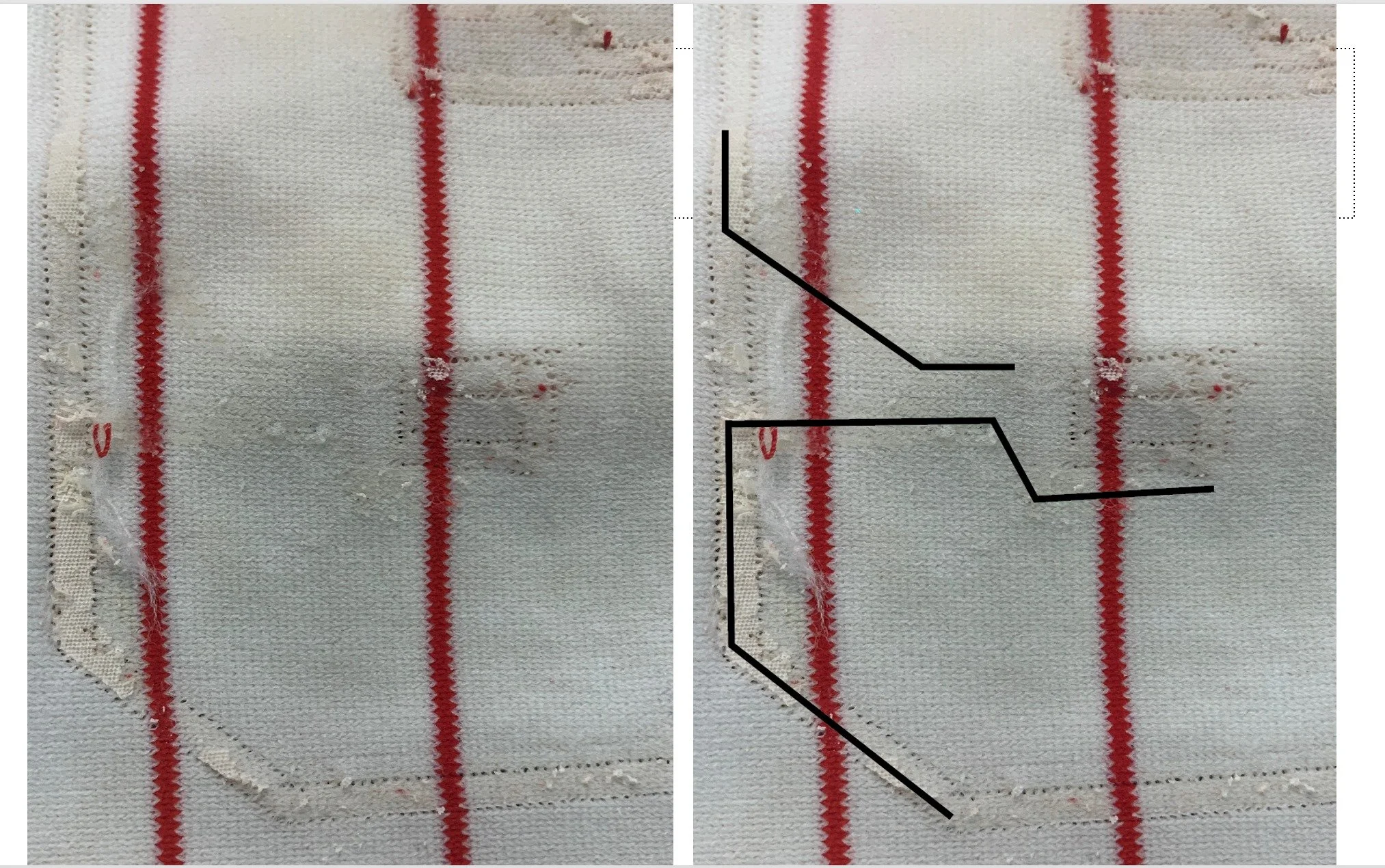
The 46 on the front looked completely original, but I decided to remove the six to see if it had perhaps been turned upside down and was originally a nine. When I did, very faint ghost lines from old stitching on the shirt and some flecks of dried glue in the single spot I expected to see it confirmed my suspicion. The front numbers were very probably the originals, and the second digit had been turned upside down and re-stitched in place. My guess was that the leading 4 was original and had never been removed. It's probably the only original stitched element remaining on the shirt.
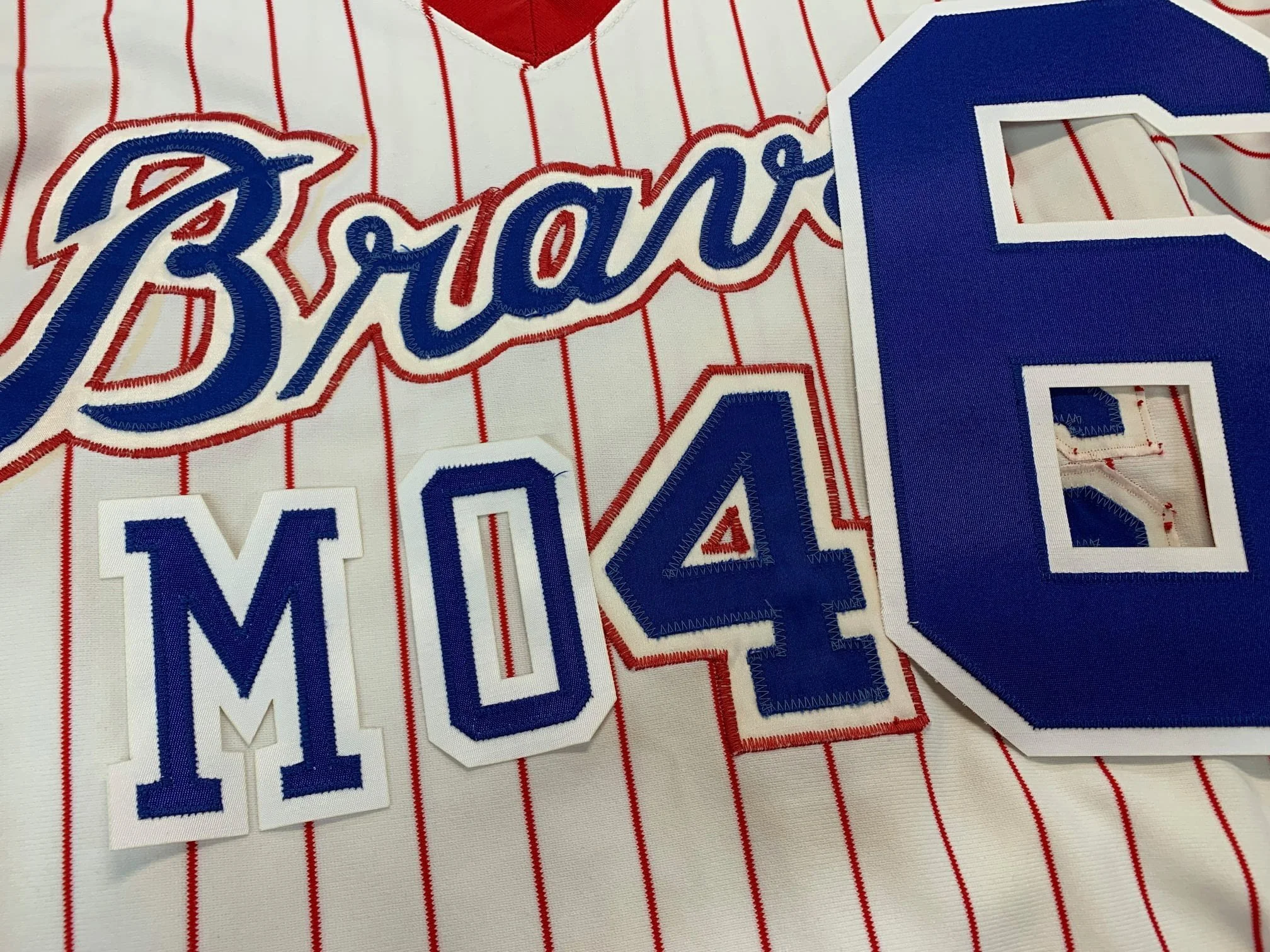
Using the ghost outlines of the numbers and name letters from the back, I re-created these in the appropriate colors of two layer tackle twill. The back numbers are a huge 9 1/2 inches tall. I don't think there's ever been taller back numbers on a jersey in major league baseball, ever.
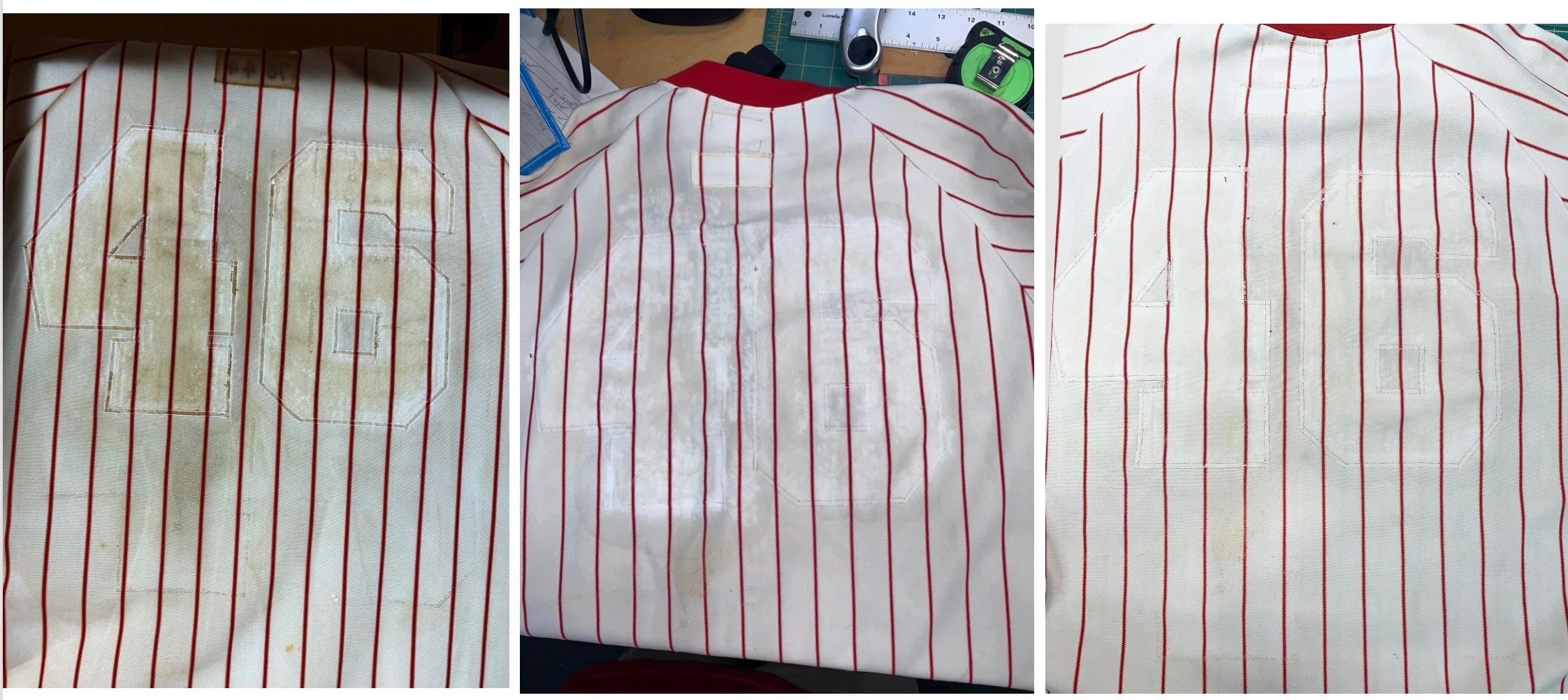
Our forensic work complete I now turned my attention to cleaning this filthy shirt. It was so stained with years of dirt, and caked with dried crusty adhesive, that when put on the light table you could barely see through it in some spots. I have learned one of the dangers of cleaning very dirty fabric is that you can over-clean it in parts, ending up with bright white spots that the rest of the shirt can’t hope to ever again match. So I proceeded with care. You can see in this picture that I was able to remove most of the glue that had been layered on underneath both the original and current numbers. Now it was my job to make the rest of the shirt at least as white as this. I use chlorine bleach only as a last resort, and I did not have to use it on this one. After wetting the jersey and literally soaking it with Oxiclean pre-treat spray, I let it sit for almost a full day, then soaked it in a bucket of water with Oxiclean powder, agitating the water every hour or so. I machine-washed it twice using Oxiclean and non-chlorine bleach, and the result was stunning. The jersey color evened out to the point where it looked quite presentable indeed. This represented over an hour of intense work.
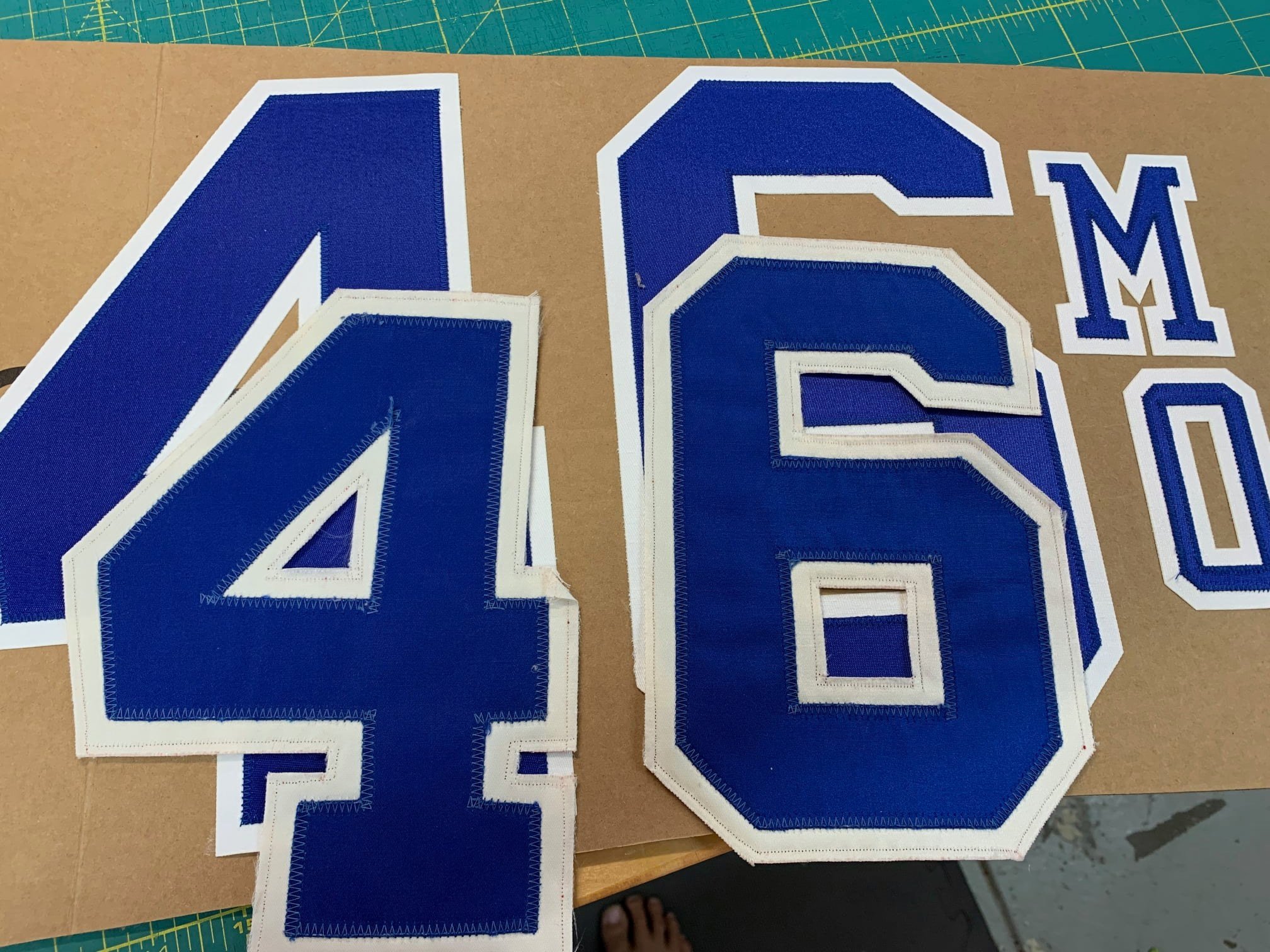
The next step is to make the new lettering match the old in terms of color and patina. After being washed dozens of times and worn on the field in dozens of games, the twill lettering doesn't look very much like it did when it was new. The shine is gone, and white fades to beige. I've done enough of these now that I have ample experience with both media blasting and organically dying new lettering to make it approximate the look of the well worn originals. I proceeded to execute that process in the sandblaster and on the stove, to make the old lettering looked like it belonged.
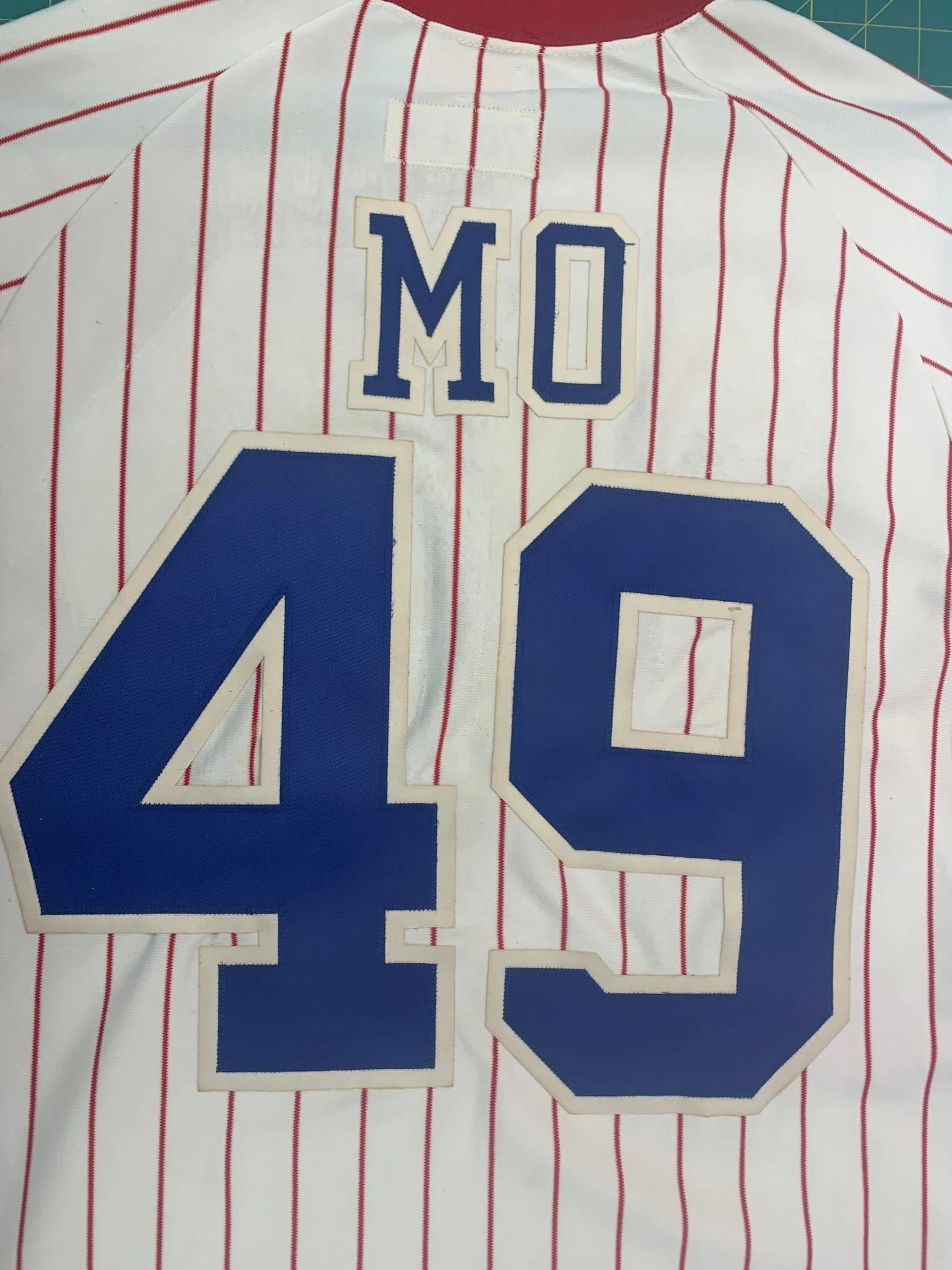
Finally, tacking the now-aged lettering in place over the old outlines required me to actually slightly pucker the fabric of the shirt beneath the new numbers. In its decades of use the Jersey had become misshapen, and to make all of the lines of the jerseys pinstripes match the appropriate places on the numbers I was stitching on top, I had to perform some minor manipulation. You can see that the back numbers are not completely straight and perpendicular to each other. Part of this is due to the stretching of the shirt through years of use, and frankly they probably never were exactly aligned in the first place; looking at the historic picture seems to confirm that. . Our job is to restore things to the way they once looked, not to make them look new and perfect.
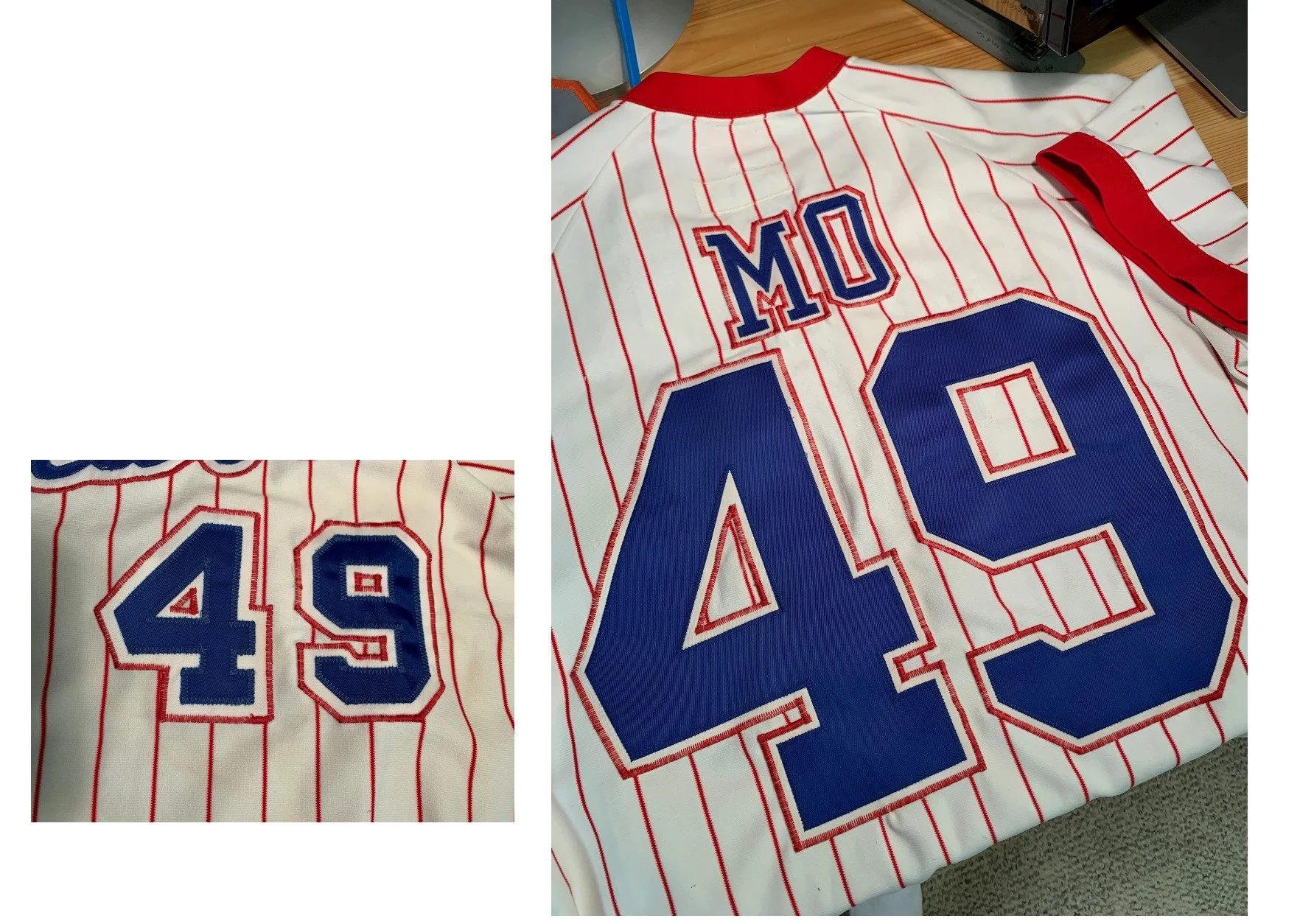
Next step was to turn this over to Emily, the Dream Shop’s expert stitcher, and ask her to re-create the embroidery stitch around the edges as closely matched as possible to the other original elements on the shirt. I probably have 10 different shades of red embroidery thread that I keep on hand for this type of a project. We found one that was the closest match to the stitching that was around the original number four on the front and the Braves wordmark
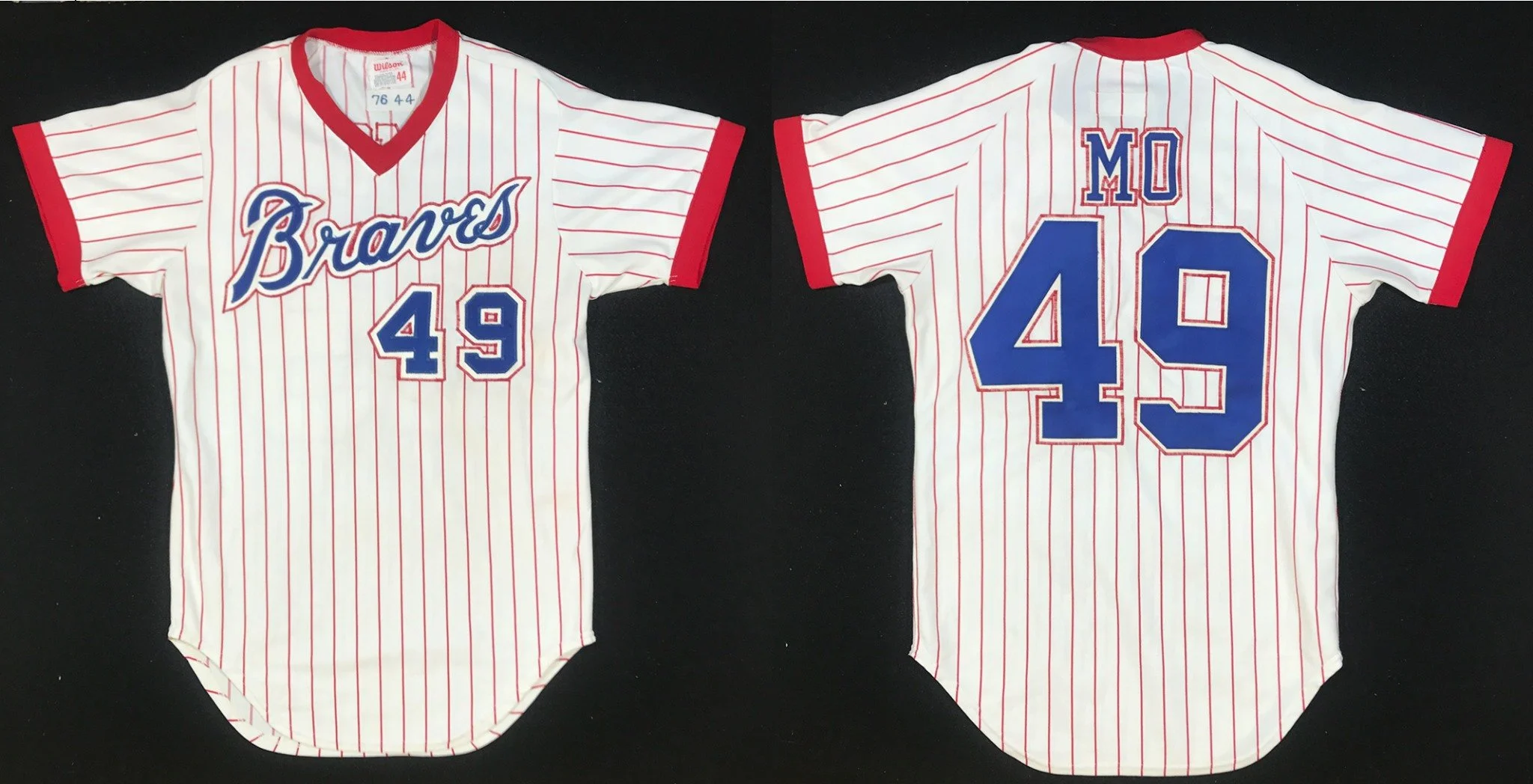
Here is the end result. I think he will agree that we did a pretty good job!
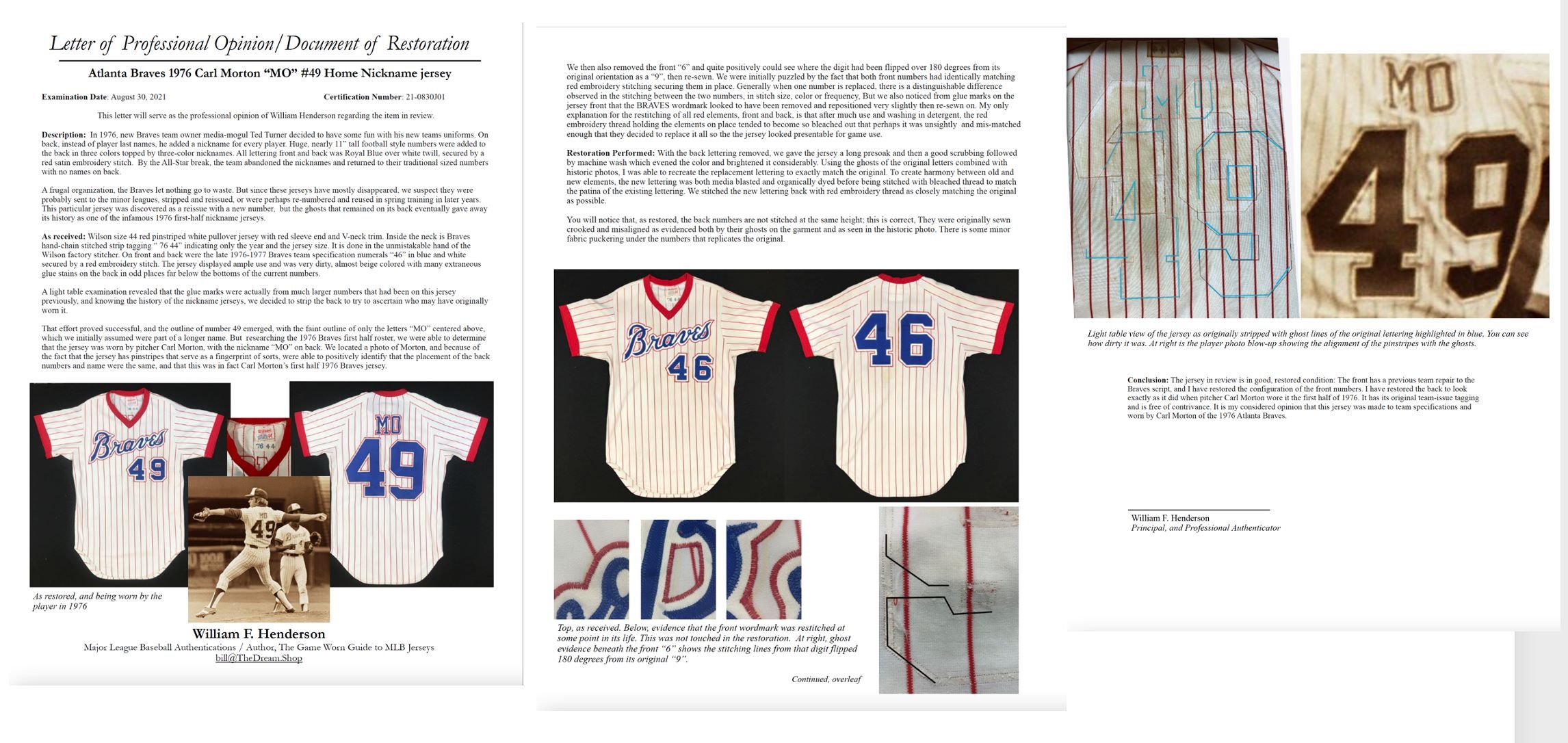
Performing a historic restoration like this carries some important responsibilities. Simply restoring the garment isn't enough. It requires a full authentication, as well as complete pictorial documentation of the restoration. I did both on this historic piece.
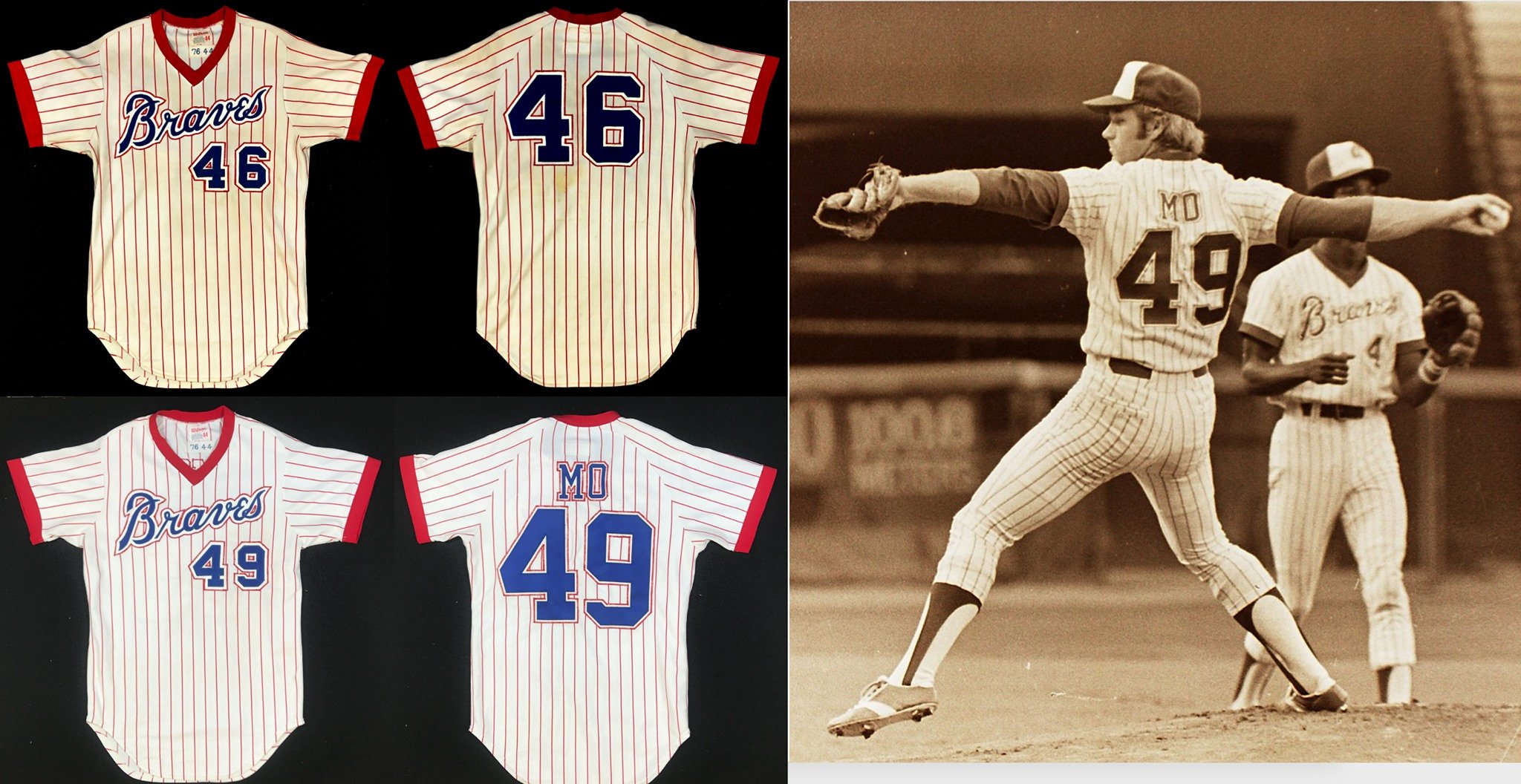
I hope you enjoyed reading about this project, and it might give you hope that diamonds in the rough remain out there. So many of these old jerseys were re-purposed to the minor leagues that almost any minor league jersey you find for sale quite possibly has a major league baseball heritage hiding underneath.