
Restoration / Authentication
1954 Mystery Jerseys
What in the world is this? Let's find out!
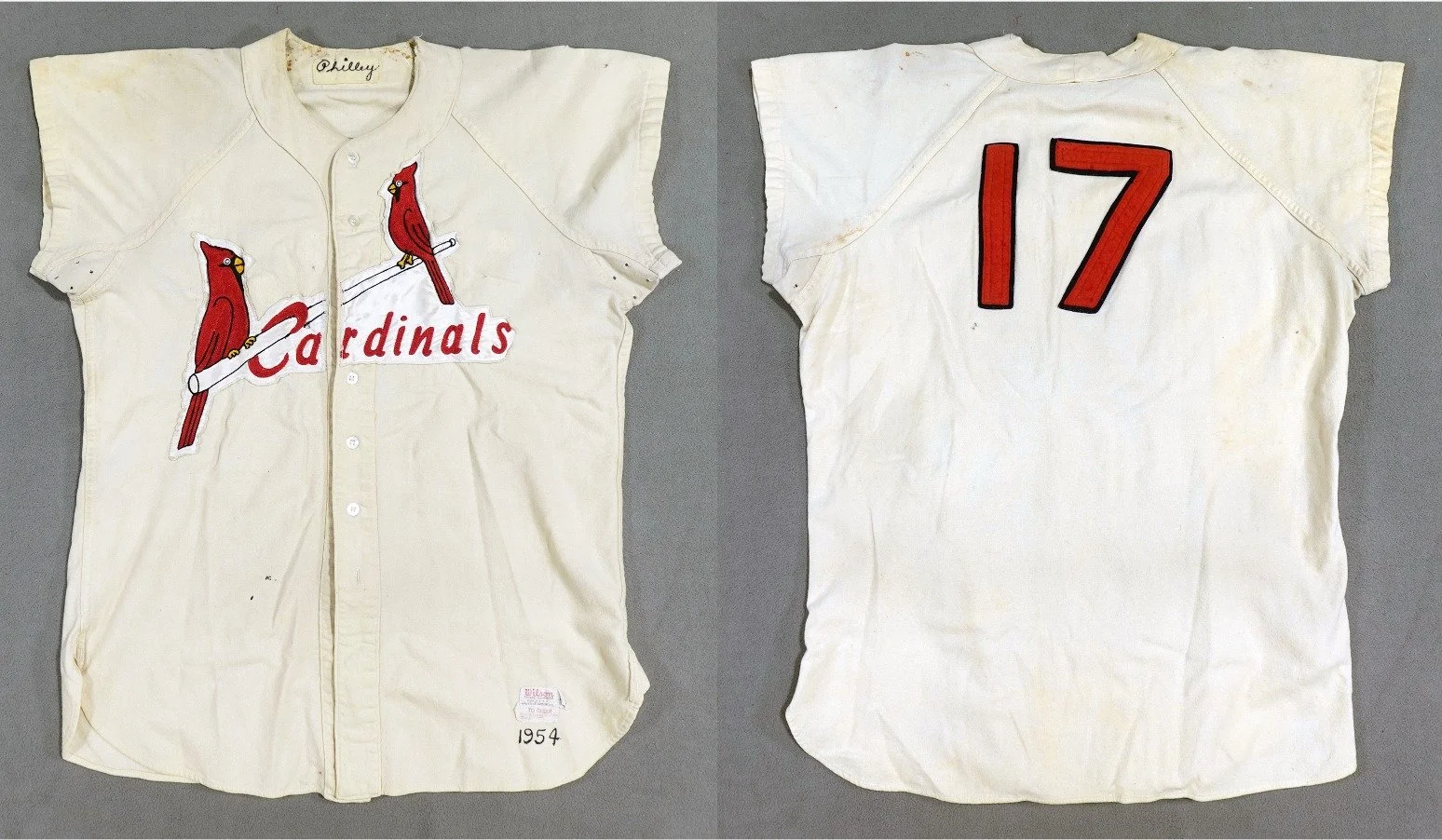
Collector Emory Liu contacted me about a jersey he had purchased, It seemed to be from a Cardinals minor league team but It had the name “Philley” in the collar and “1954” embroidered on its tail. He sent it to me to be evaluated and if warranted, to be restored. Follow along with the detective work to see what we learned, and what we did.
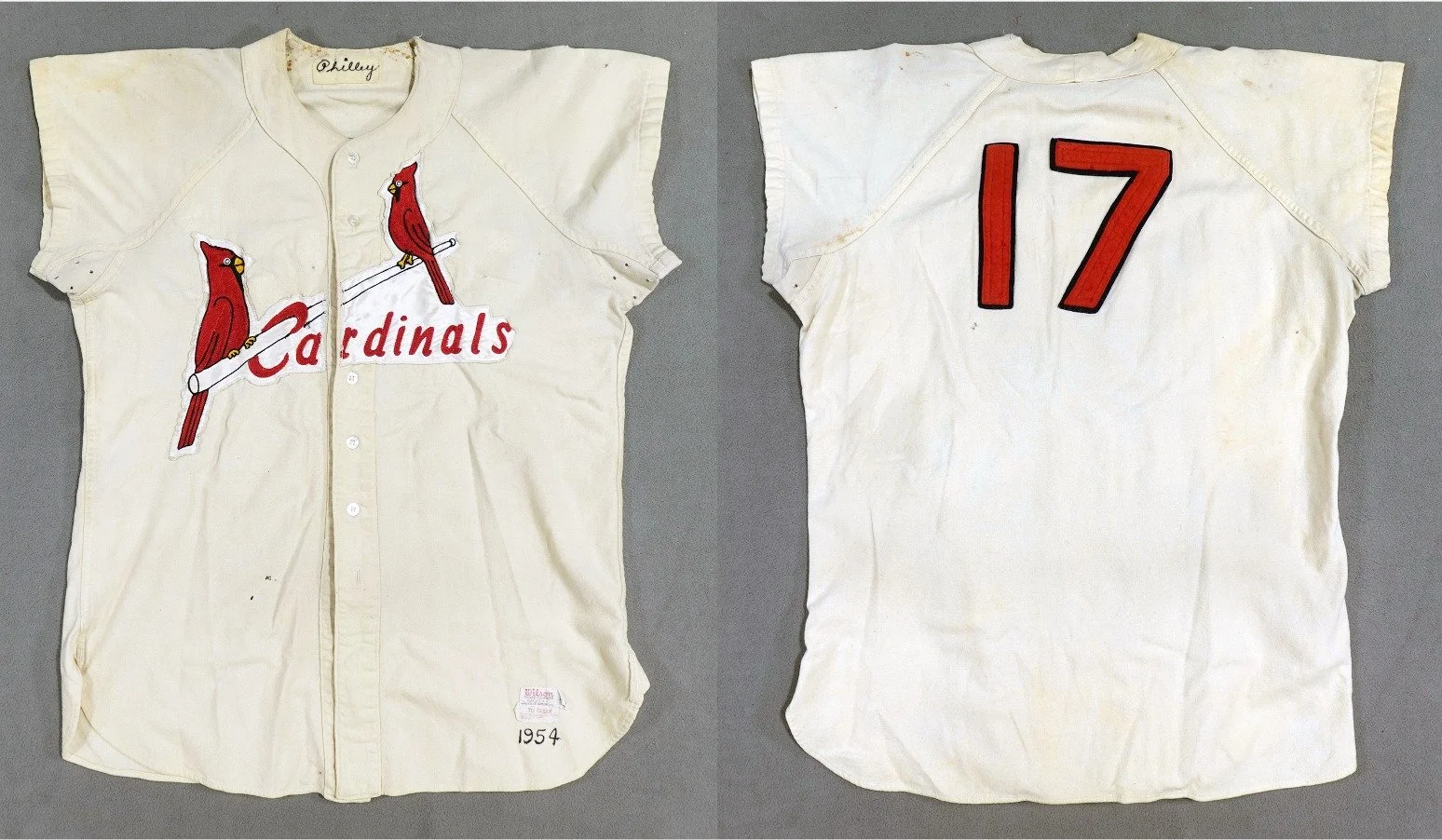
Here’s a close-up of how it looked when I received it. The Cardinals crest on the front of the shirt is clearly not major league issue, but it is not something you’d find at the beer league either. This certainly looks like a minor league conversion at first glance.
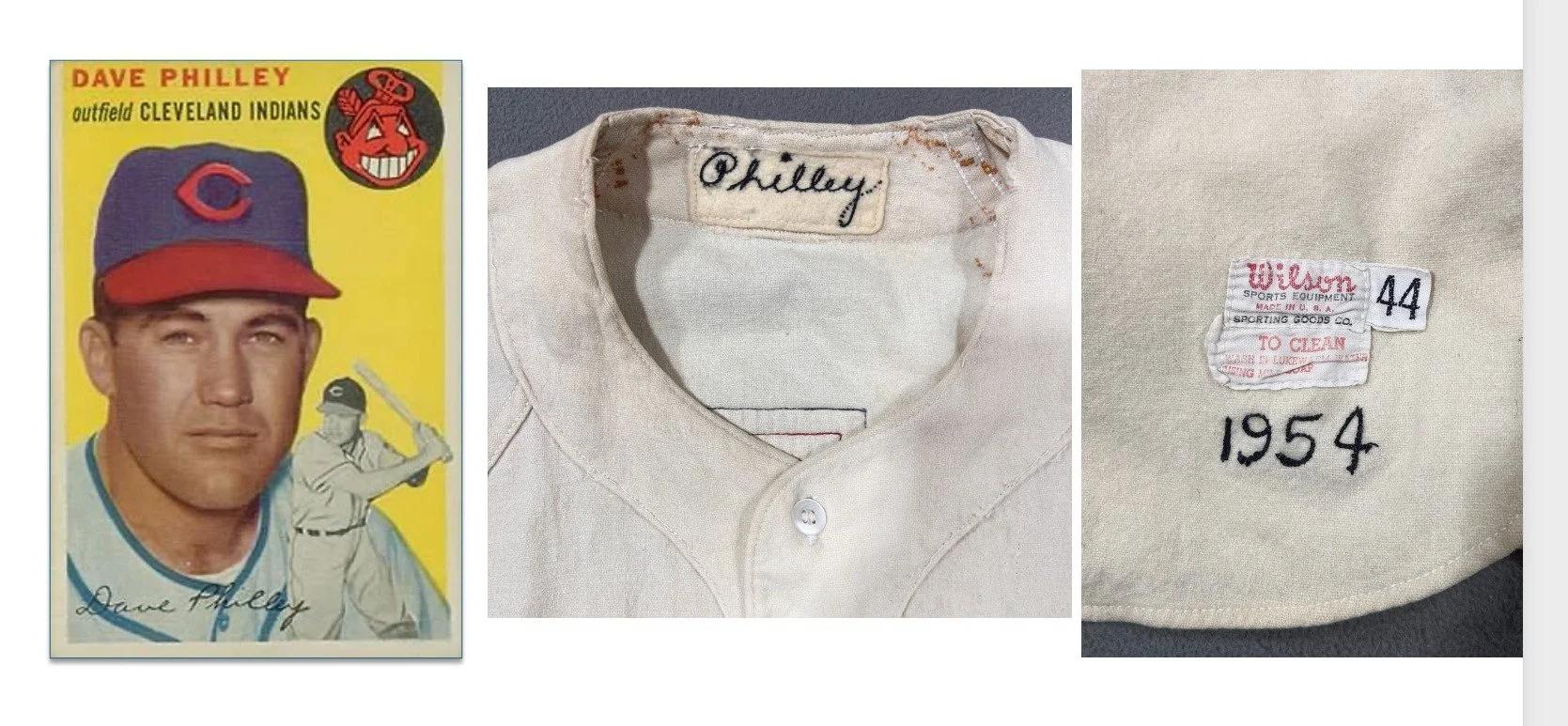
But what of the name in the collar? Dave Philley was a member of the AL Champion Cleveland Indians, and had just completed a fine season for the tribe. A search of my archives confirmed that the 1954 embroidery on the tail and the style of name in the collar matched the 1954 Indians. But the front Cardinals cover-up was so massive that it was hard to see anything beneath it. We decided to remove it to see what secrets lay beneath.
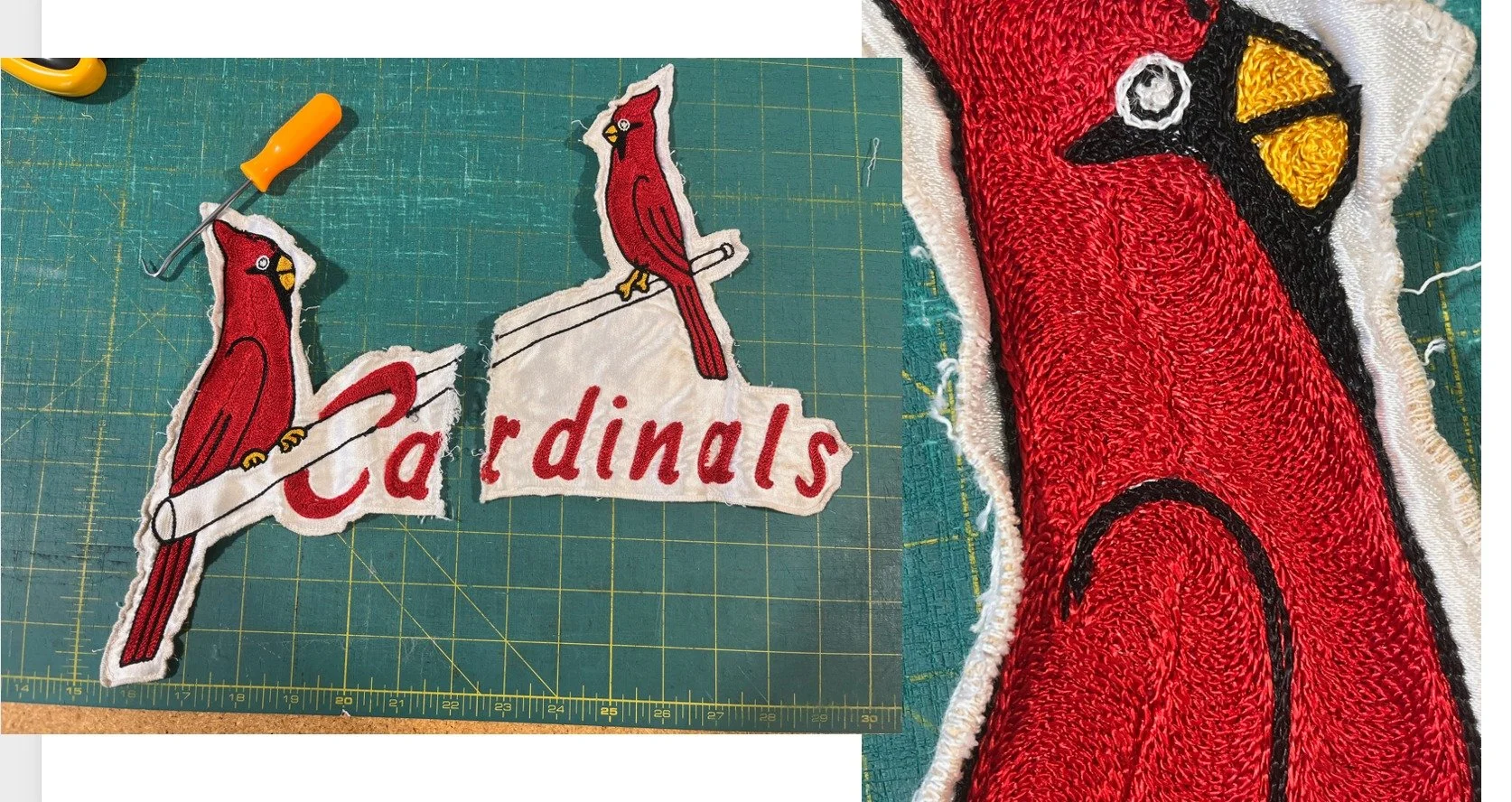
I removed the appliqué on the front one stitch at a time. It was clear that this was no hack job, the Cardinals crest on the front had been hand chain stitched in excruciating detail onto a piece of satin, its edge had been tightly bound with a surging stitch, and then the entire appliqué had been stitched to the front of the jersey. What in the world was this? We are well aware that major league teams sent their uniforms lock stock and barrel to the minor leagues when their utility there was through. But, clearly the Indians did not have any farm teams named the Cardinals using the Cardinals logo! I reason that because minor league teams change ownership all the time that the secret could be found if we located an Indians farm team that had been sold to the Cardinals in one of the seasons after 1954
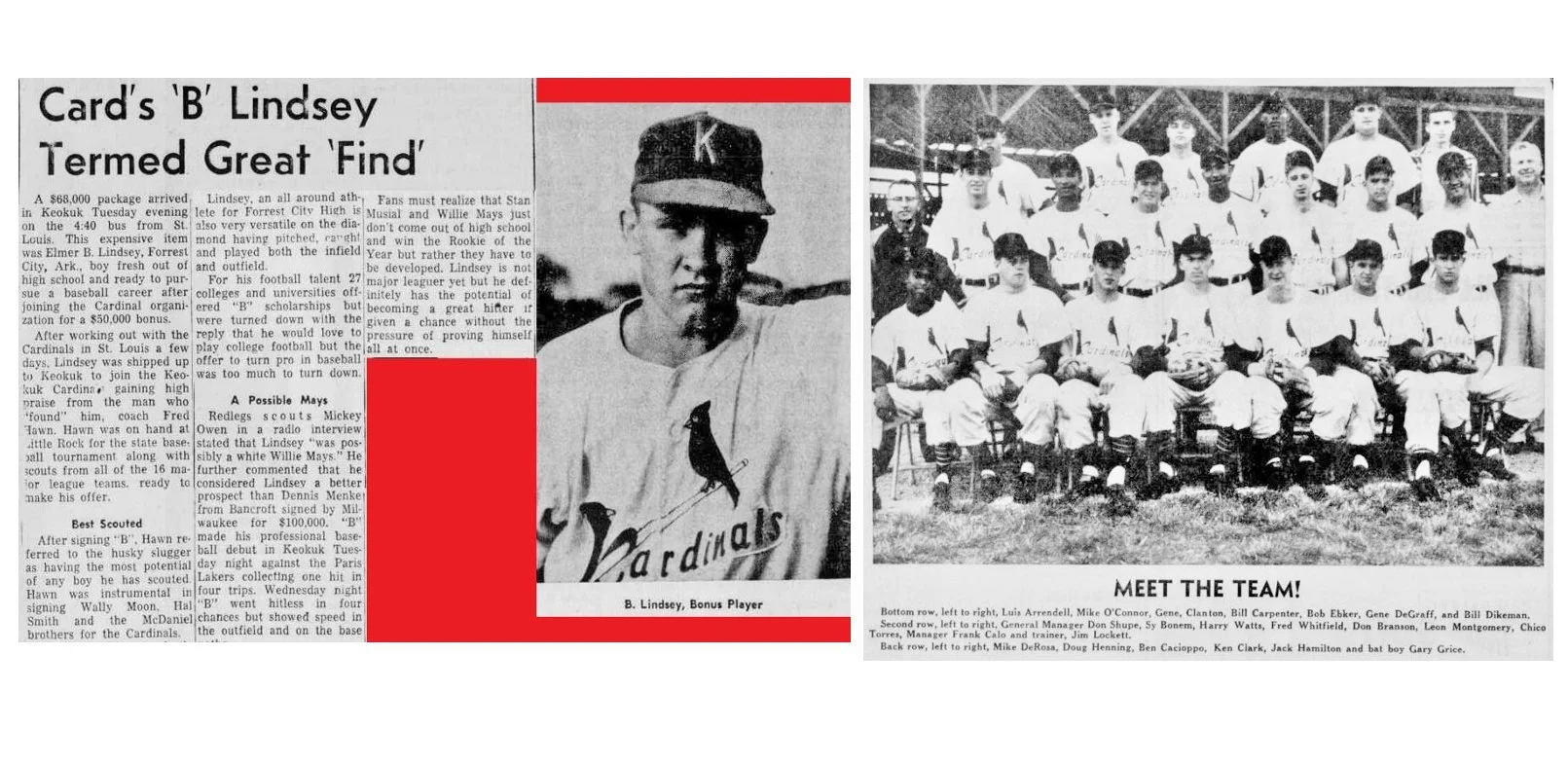
Pulling charts of all of the Indians farm teams and comparing them to the Cardinals farm teams from 1955 through 1960 revealed the answer. Research shows that the Keokuk, Iowa Minor league Level B team had been named the Kernels (Indians affiliate 1954-1957) and was then sold to the St. Louis Cardinals organization and became the Keokuk Cardinals in 1958. Newspaper photos show the 1958 Keokuk Cardinals wearing a uniform with the identical patch on the front as was on our example. Finally, the jersey was purchased by its current owner by a collector in Cedar Rapids, fifty miles from Keokuk. Whether this jersey went directly from the MLB Indians of 1954 directly to the Keokuk Indians after that season or if it took a detour to another Indians farm club first, it appears it was still being used at least four years later in the minors after its full season of MLB use in 1954!
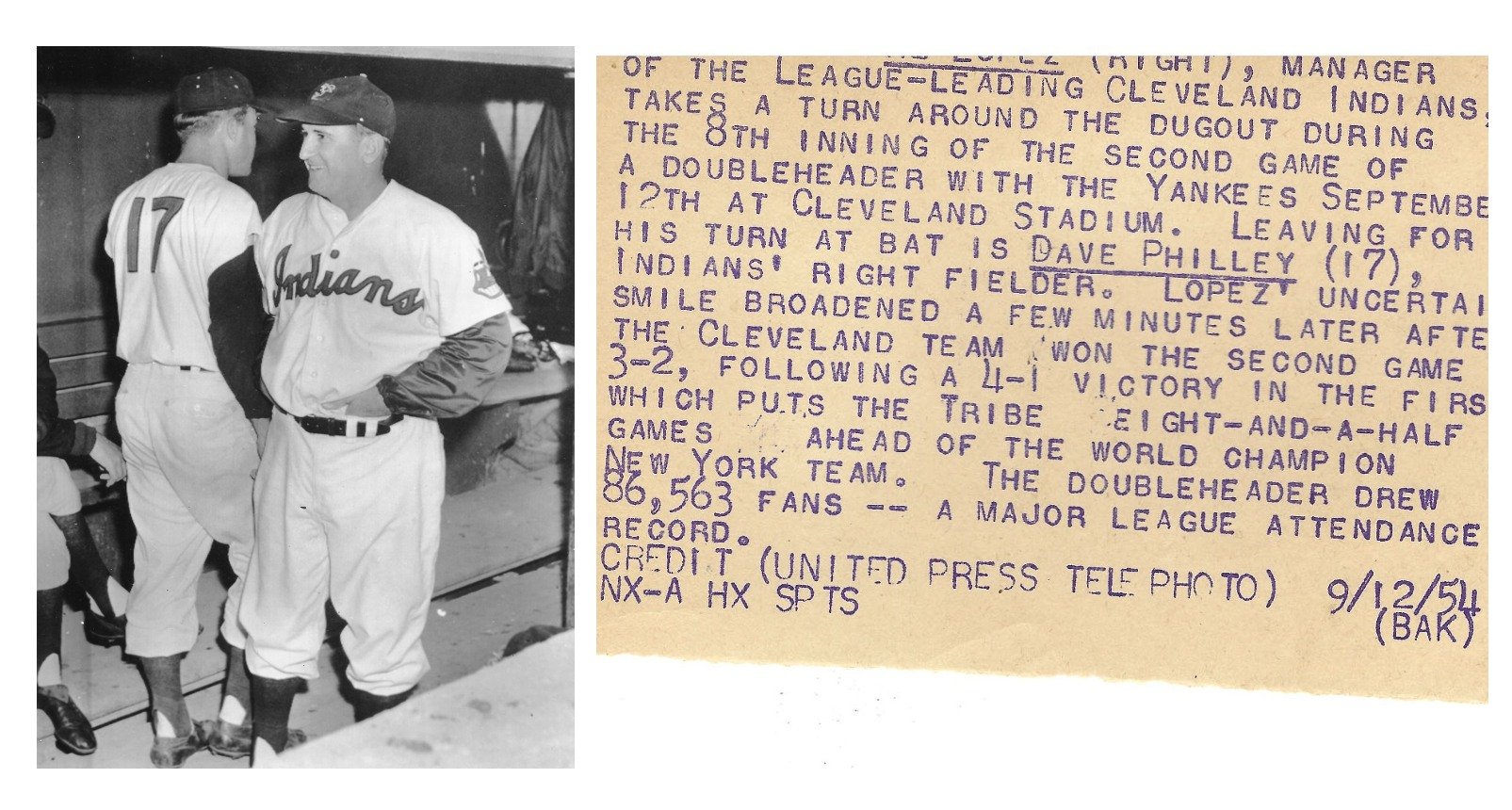
More searching in the photo archives uncovered a picture of Dave Philly standing in the Indians dugout in 1954 with his back visible. I wonder if this is the same jersey he was wearing then? Considering the players were issued only two sets of home and away jerseys in those days, there’s a 50-50 chance.
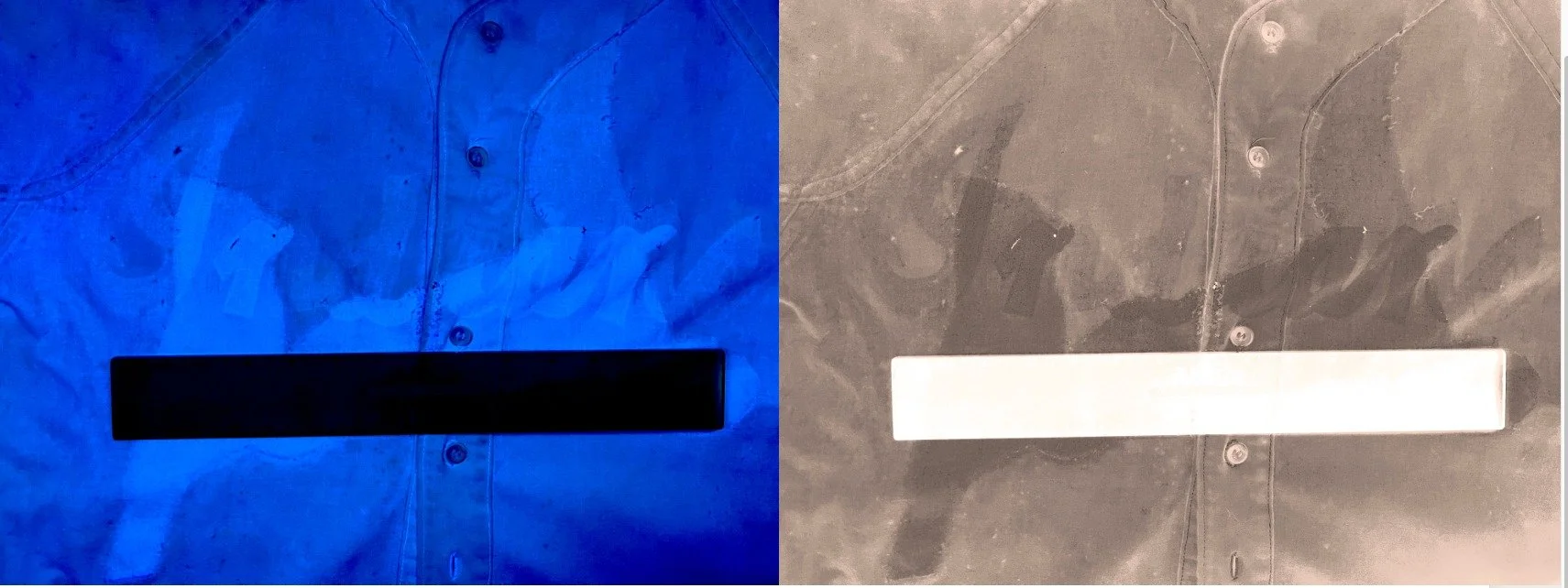
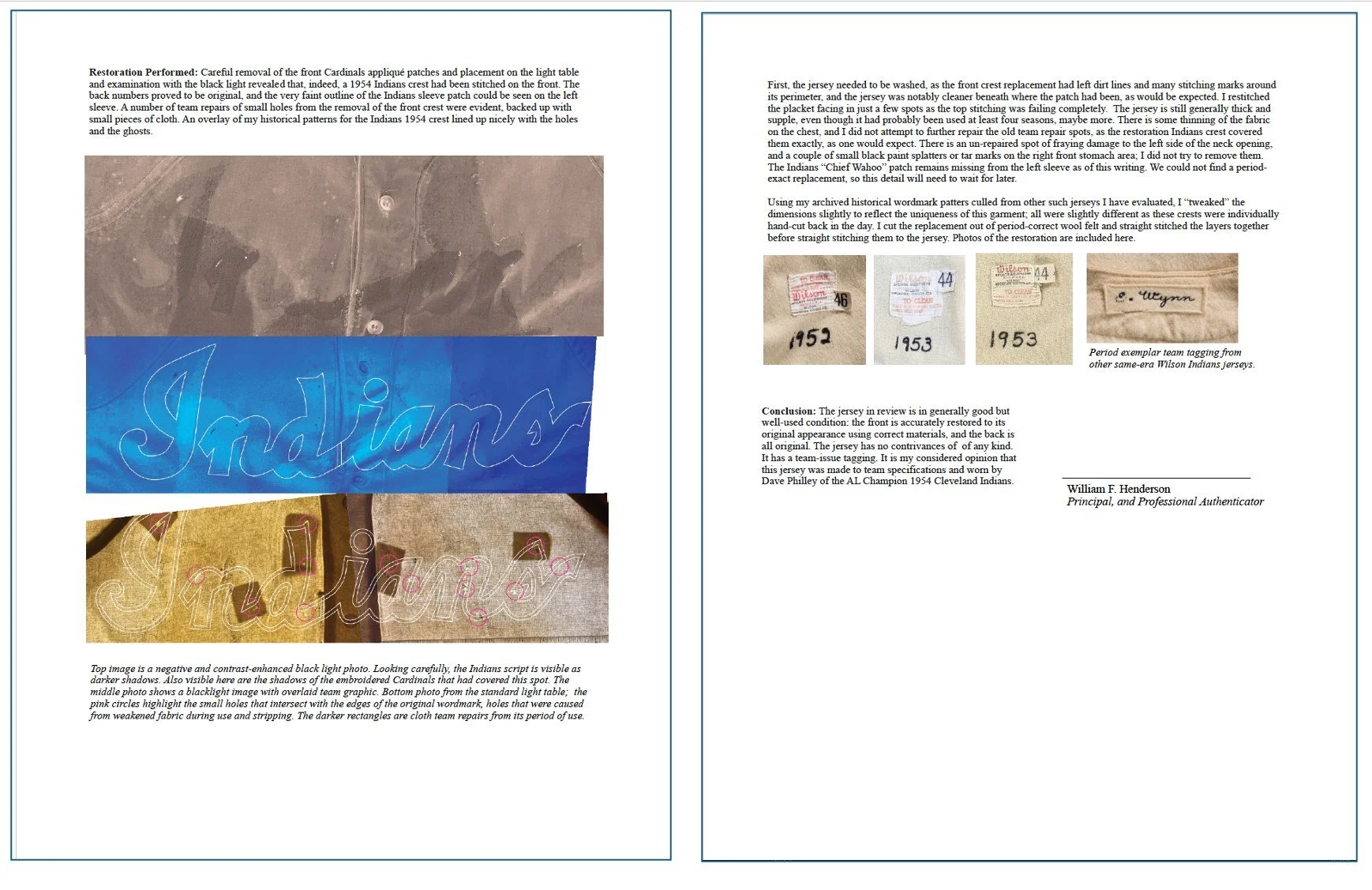
The next step was to uncover the original front word mark. Unlike today when everything is generated by computers and laser cutters, back then the work was done using a paper pattern, talcum powder and a sharp pair of scissors. Both layers of the crest were cut by hand. The light table showed some clues, but the black light really opened our eyes. In the first picture you can see the black light image of the front of the jersey. The Cardinals' outlines are very apparent but if you look more deeply you can see the Indian script lurking behind. On the picture to the right I have enhanced the image, turned it into a negative, and made it black-and-white and we can begin to see all of the outlines of the Indians crest that had been gone from it now for almost 70 years. How does the black light work? It shows light frequencies that are invisible to our eyes. The shirt’s exposure to the sun, laundry detergents, transfer of fabric dye, and other magical factors left these ghost images of things that had been stitched to this shirt for just a short time, some 70 years ago.
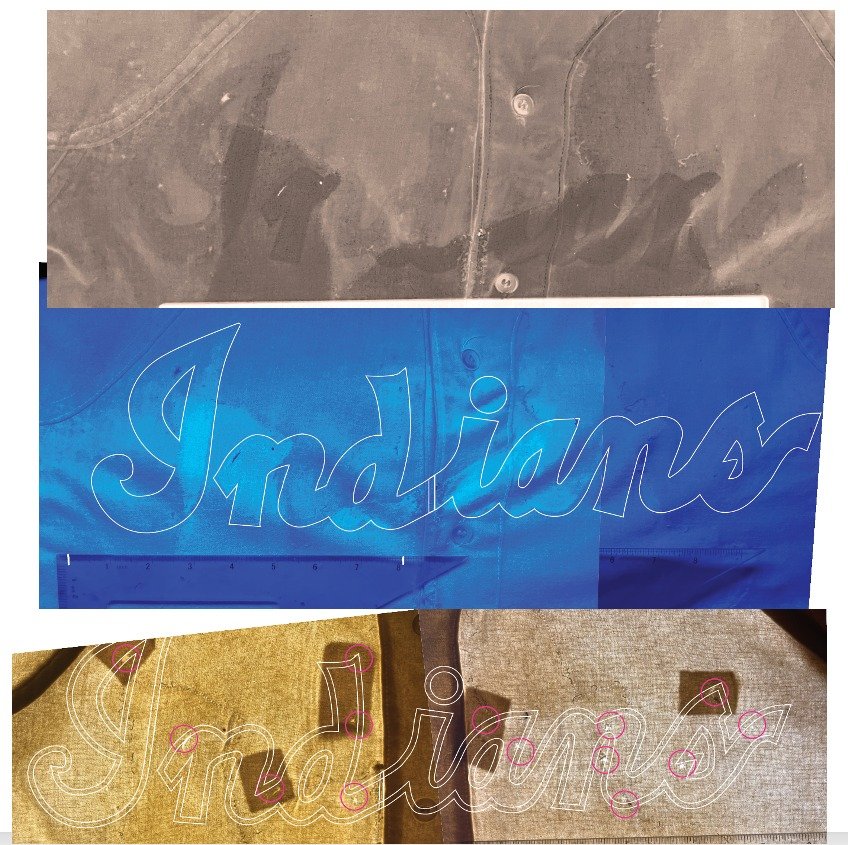
Now it was time to get to work. In this grouping of three pictures I was able to take stock artwork I had created some years ago to restore another Indians jersey and lay it on top of this jersey. Not surprisingly it did not exactly match. This happens because of the reason I mentioned before, everything had been done by hand and who knows the same paper patterns were used in all cases, likely not. Secondly fabrics shrink over time, sometimes significantly. I was able to tweak the pattern to match the ghosts exactly. If you look closely at the bottom photo, see all of the red circles that I’ve made that highlight small holes at the point of intersection of the old logo on the shirt. The darker rectangles are fabric patches that were applied by the team to cover holes made in the shirt from the removal of the original Indians crest. Those holes were created when fabric was weakened by removing the old emblem decades ago. The new logo will be stitched directly over the old ghosts making it invisible. That’s why it is so important to document any restoration like this. The better the restoration the harder it is to see what had once been there so long ago!
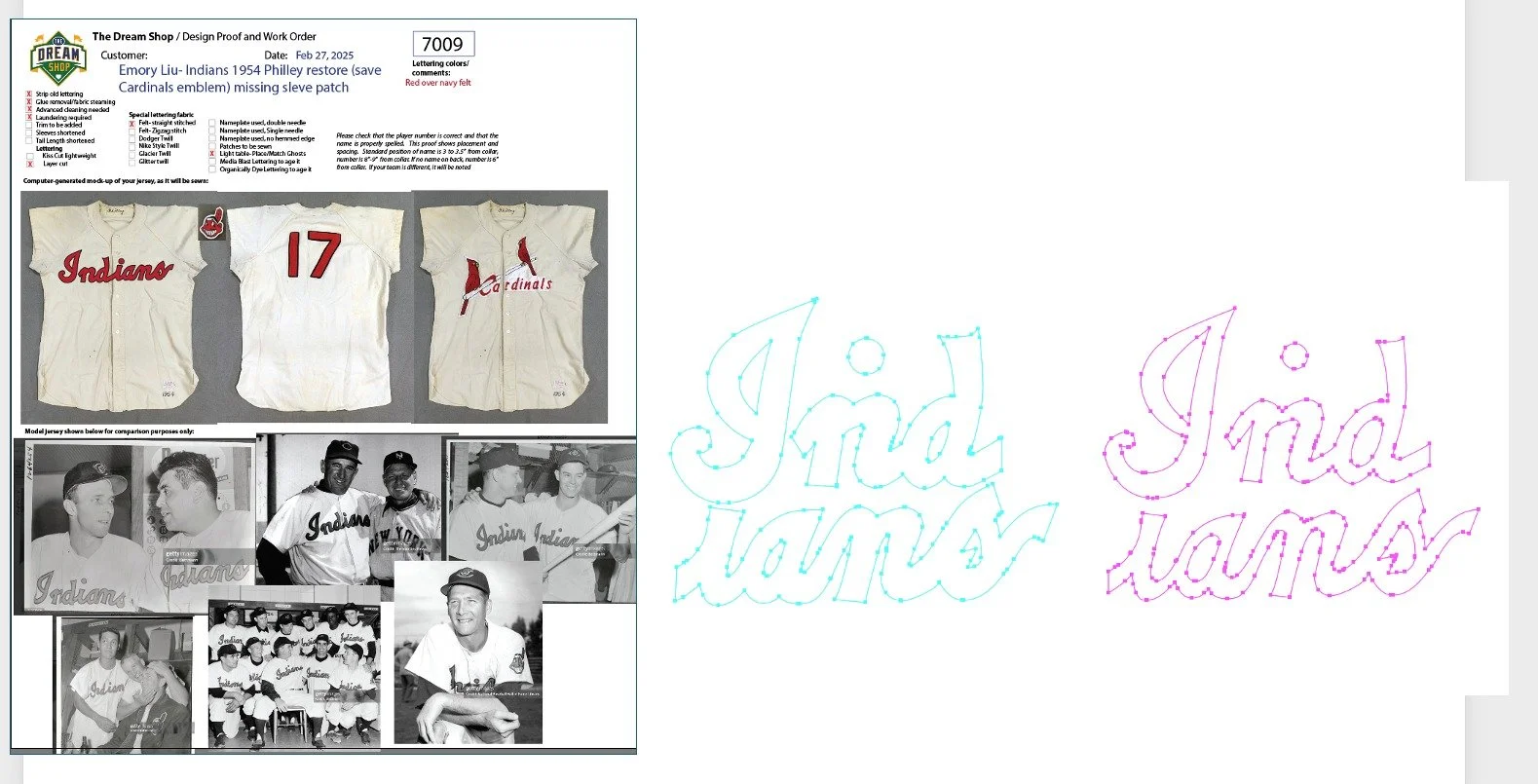
At my shop, every project has a complete work order constructed for it. That way I know exactly what I’m doing as it goes through all the processes. You can see my proof at the left, with many pictures of Indians jerseys below which helped me see all of the tiny details in the curves on the script. At right you can see my actual vector cutting patterns which were sent to the laser cutter. Each color of felt is cut separately and then adhered together and straight stitched just the way it was in 1954
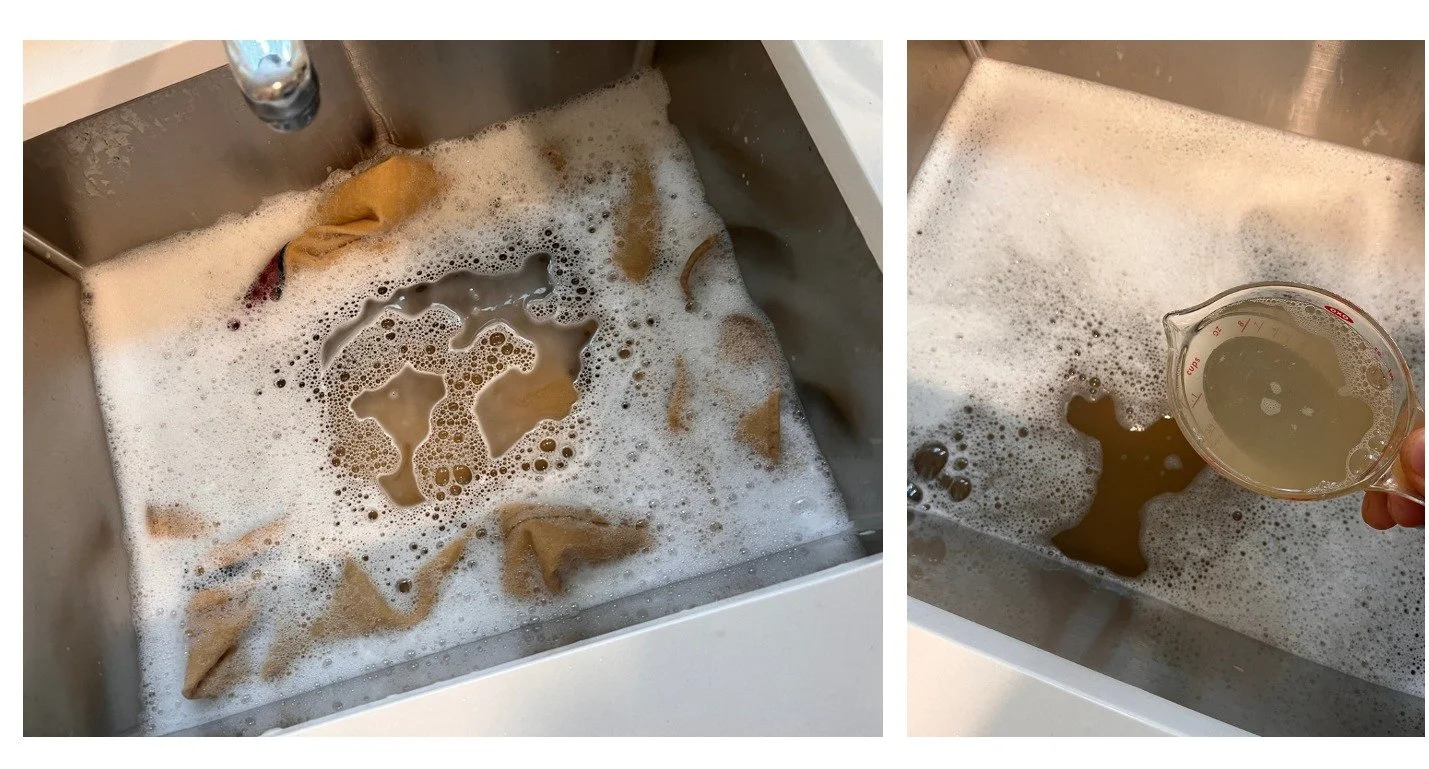
In a step that might seem frightening to the uninitiated, this jersey needed to be washed. Removing the Cardinals crest from the front had left a large cleaner area underneath where the fabric had been spared a season or more of ground in dirt. The Dream Shop stainless steel utility sink has seen it share of royalty. Warm water, Woolite and a gentle hand agitation pulled massive amounts of dirt out of this old fabric. You can see the dirty color of the water in the measuring cup at the right. The result is a jersey that is much brighter than it came in the door. And clean fabric is happy fabric; it’s just not a good idea to leave old jerseys full of dirt, which includes mold spores and fungus which can eat away at the fabric. Besides making the jersey look better, this step will make it last longer.
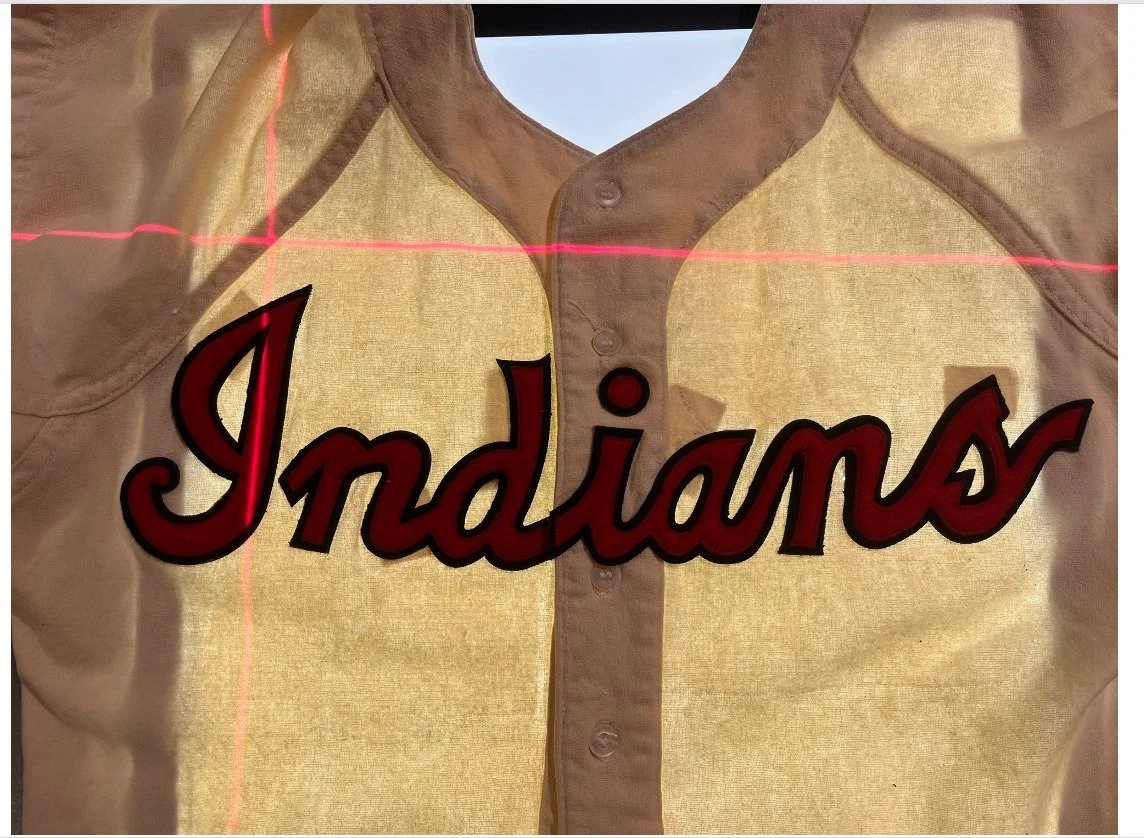
Now that the felt has been cut and the two layers stitched together, I overlaid the belt onto the jersey and was pleased to see that all of the ghosts and tiny holes that I had highlighted were perfectly matched by the new Indians crest that would soon again cover them. (Note- for the curious, the laser crosshairs are on our setup table. I use lasers to make sure everything is applied straight and true.)
Now that the felt has been cut and the two layers stitched together, I overlaid the felt onto the jersey and was pleased to see that all of the ghosts and tiny holes that I had highlighted were perfectly matched by the new Indians crest that would soon again cover them.
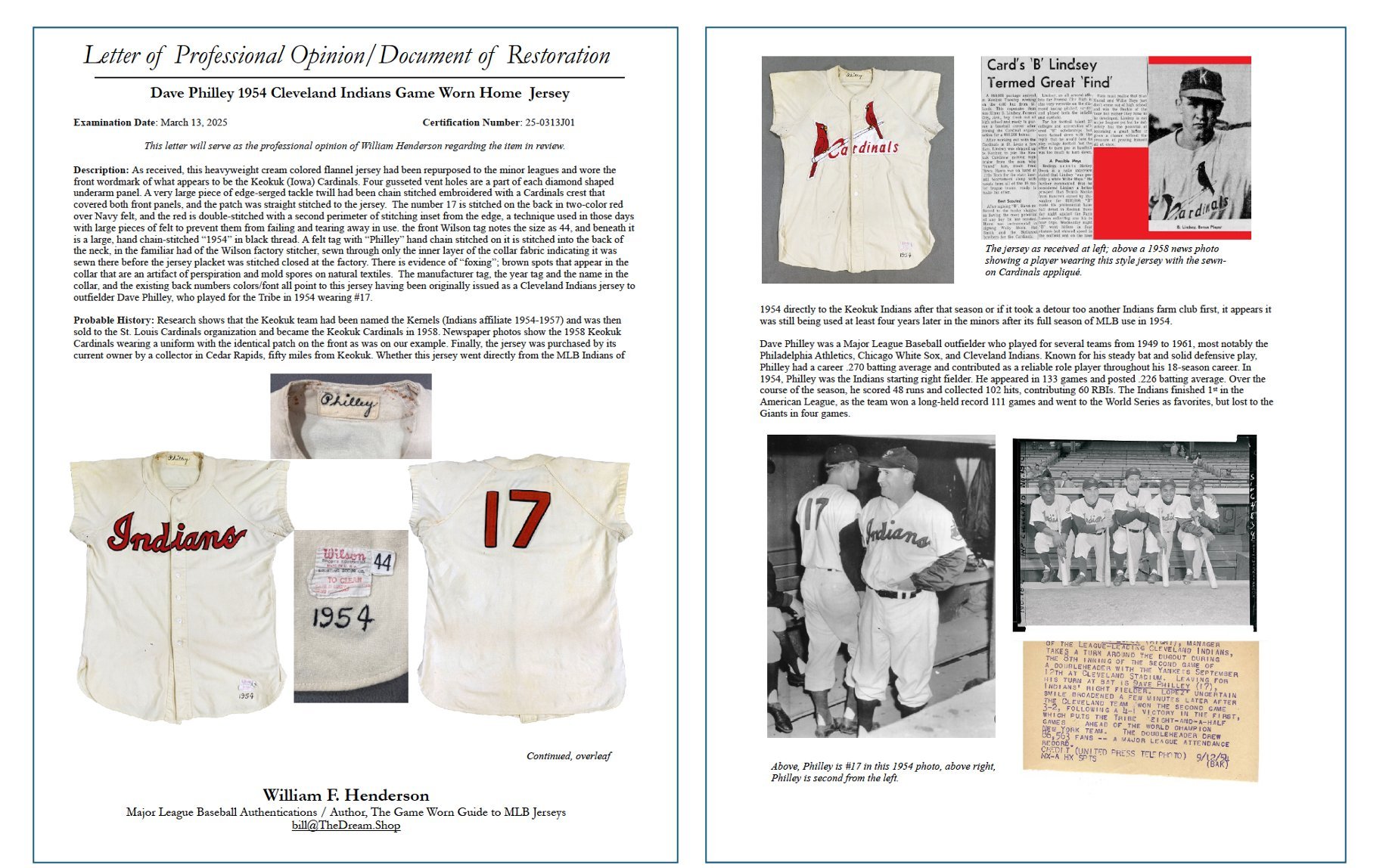
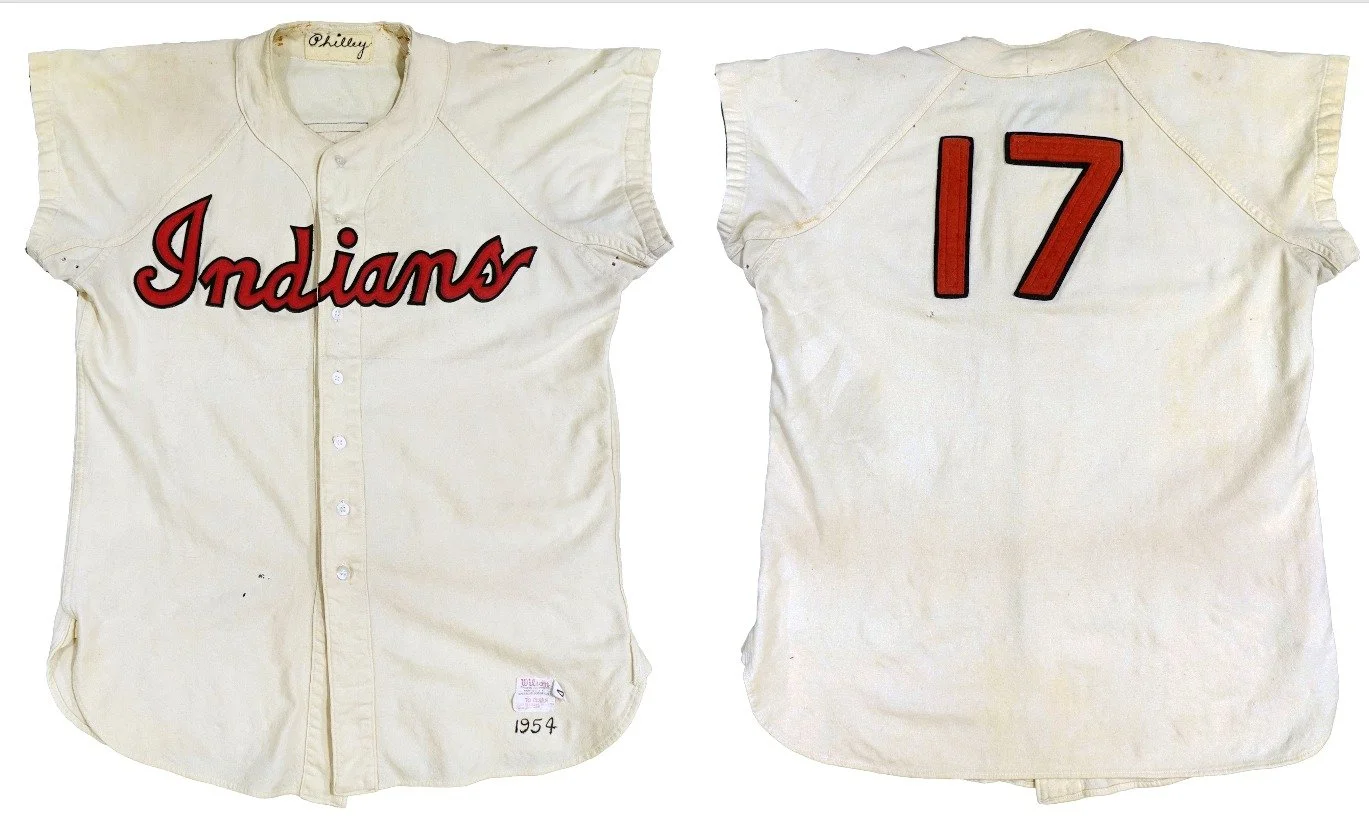
Every restoration deserves to be documented. Here I share the four-page letter of opinion documenting its restoration for your review. Besides being nice to have, a document like this cement the value of the jersey. I’ll mention something that most people never think of: when an item like this is restored to its original configuration, and a future evaluator places it on the light table the only thing he will see is the ghosts of the Cardinals crest that we removed from the front. He will know it has an Indians crest restored to the front but he won’t be able to see any evidence of what was originally there. That’s a credit to us, we completely covered up every last ghost and pinhole with the replacement crest that exactly matches the old one that had been removed. Without a letter documenting the restoration, the likely result would be that the evaluator would consider this a fabrication; an Indians jersey created on top of the Cardinals one. And that would be incorrect. And it would be a shame.
I hope you have enjoyed this project. We do all sorts of work at The Dream Shop, from MLB authentications and restorations to the more common projects, lettering people’s store-bought authentic jerseys to make them look just like they were worn on the field. If you have a project that you’d like to consider, please write to me, Bill@theDream.Shop.